Seeschlacht in der Bucht von Quiberon

The Battle of Quiberon Bay, 20 November 1759 label QS:Lfr,"Bataille des cardinaux"label QS:Len,"The Battle of Quiberon Bay, 20 November 1759"

Portrait in three-quarter-length showing the sitter turning to the right but facing towards the left. He wears flag-officer's undress uniform, 1767-83, of blue jacket and gold braid with the ribbon and star of the Order of Bath and a tie-wig. He holds his sword in his right hand and stands against a rocky background with, on the left, the fleet at anchor together with a barge flying the Union flag.

Monument to Admiral Lord Hawke - St Nicolas' church, North Stoneham (detail 2)

An Allegorical Set of Portraits Commemorating the Victory at Quiberon Bay in 1759 George II, seated is shown the Fleet by William Pitt the elder, Admiral Hawke and Lord Anson 1st Lord of Admiralty to right. Britannia, with putti bearing an ensign and banners decorated with the crescent moon (Anson) and the pilgrim's staves (Hawke), Fame hovers over the Admirals. National Trust, Shugborough Hall, near Stafford transferred to the National Trust in part-payment of death duties to the Treasury, following the death of Thomas, 4th Earl of Lichfield Medium oil on canvas Measurements H 100.5 x W 124.5 cm Accession number 1271043

Anchor supposed to have belonged to the ship L'Eveillé (64 guns), a protagonist of the Battle of Quiberon Bay (November 20, 1759). It was fished up at the entrance to the Vilaine in August 1969, by the owner Yvon Joncour, and crew of the trawler at La Turballe Dohé. It is located at the front patio of the Town Hall of La Turballe.

en:Battle of Quiberon Bay. Engraving after the painting by Richard Perret ("Dessine par R Perret." lower left/ "Jean Simond Sculp 1806" lower right.) Published according to Law March 16, 1806 in Brest, Sold by the Editor, Leunault a l'Arsenel. Richard Perret. " Caption beneath the image: "A L Hon ble Sir Edward Hawke Amiral du Bleu el Chevalier du Tres On rbl Ordre du Bain Representation de la Glorieuse, Defaite de la Flotte Francoise commandee parle Mare chat Conflans de Belle Isle le 20 Novembre 1759 operee par la flotte de Sa Majeste Britannique sous Son Commandement. Les Vaisseaux. Francois furent defaits pendant qu ils escortoient un corp d espedition pour envahir loes Domaines Britanniques. La representation est humblement dediee par le tres obesissant serviteur. Publie selon la Loy 16 Mars 1806 a Brest, Se vend chez l'Editeur, Leunault a l'Arsenel. Richard Perret.".

Le vaisseau le Superbe sombrant sous les coups du Royal Georges à la bataille des Cardinaux le 20 novembre 1759. Erreur sur l'image : le Superbe y est présenté comme une frégate alors qu'il s'agit bien d'un vaisseau de ligne. Gravure de la fin du XIXème siècle.

The Battle of Quiberon Bay, 20 November 1759.
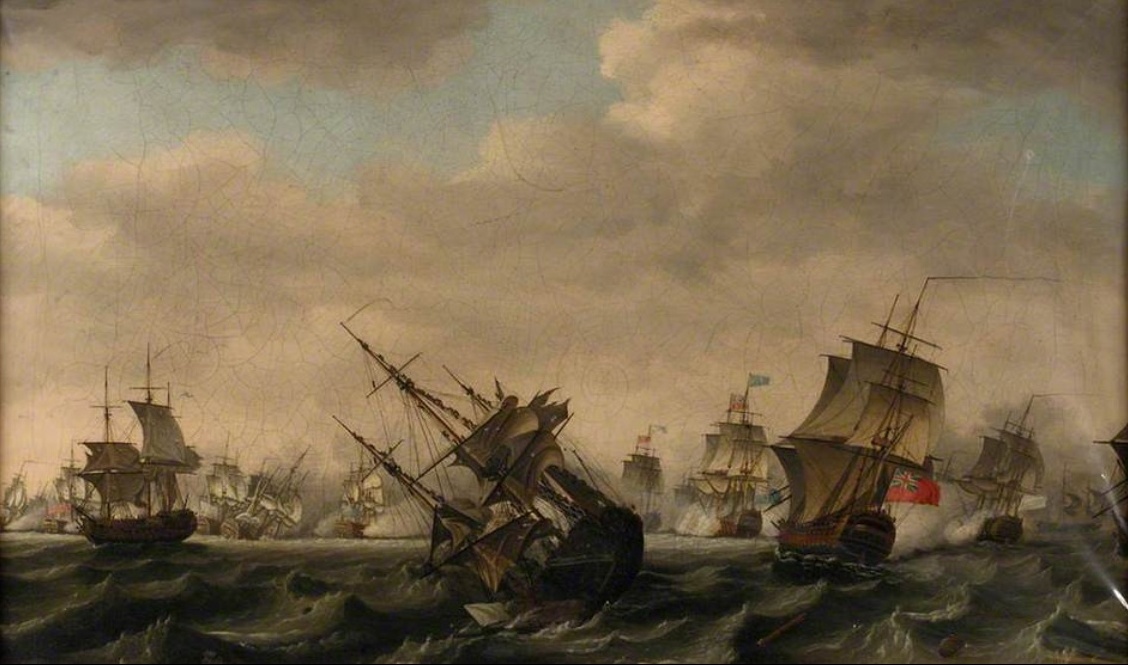
The Battle of Quiberon Bay, 20 November 1759. In this view from astern of the action, looking towards the French coast, the ship sinking in the centre is the French Thesee, with Augustus Keppel's Torbay to the right. Between them in the distance de Conflans' Soleil Royal is engaged with Hawke's 'Royal George', right, flying his blue command flag at the mainmast. Another French ship, the Superbe is sinking in the left distance, largely swamped (as was the Thesee) by water coming through her lower gunports. (nmm.ac.uk).

Vue générale de la bataille des Cardinaux le 20 novembre 1759. Guerre de Sept Ans. A gauche au premier plan : représentation possible du Thésée sur le point de chavirer dans un coup de vent en combattant le HMS Torbay.

The French Soleil Royal and Héros are in flames on the right, in the foreground HMS Resolution lies wrecked on her starboard side. In front of her is HMS Essex, with other members of the British fleet at anchor in the background. The captured French Formidable is attended by a British frigate on the left of the picture.

Battle of Quiberon Bay more information

Battle of Quiberon Bay more information

Battle of Quiberon Bay, 20th of November (1759)

Battle of Quiberon Baylabel QS:Len,"Battle of Quiberon Bay"label QS:Lfr,"Bataille des Cardinaux"

Cardinaux-royal-george
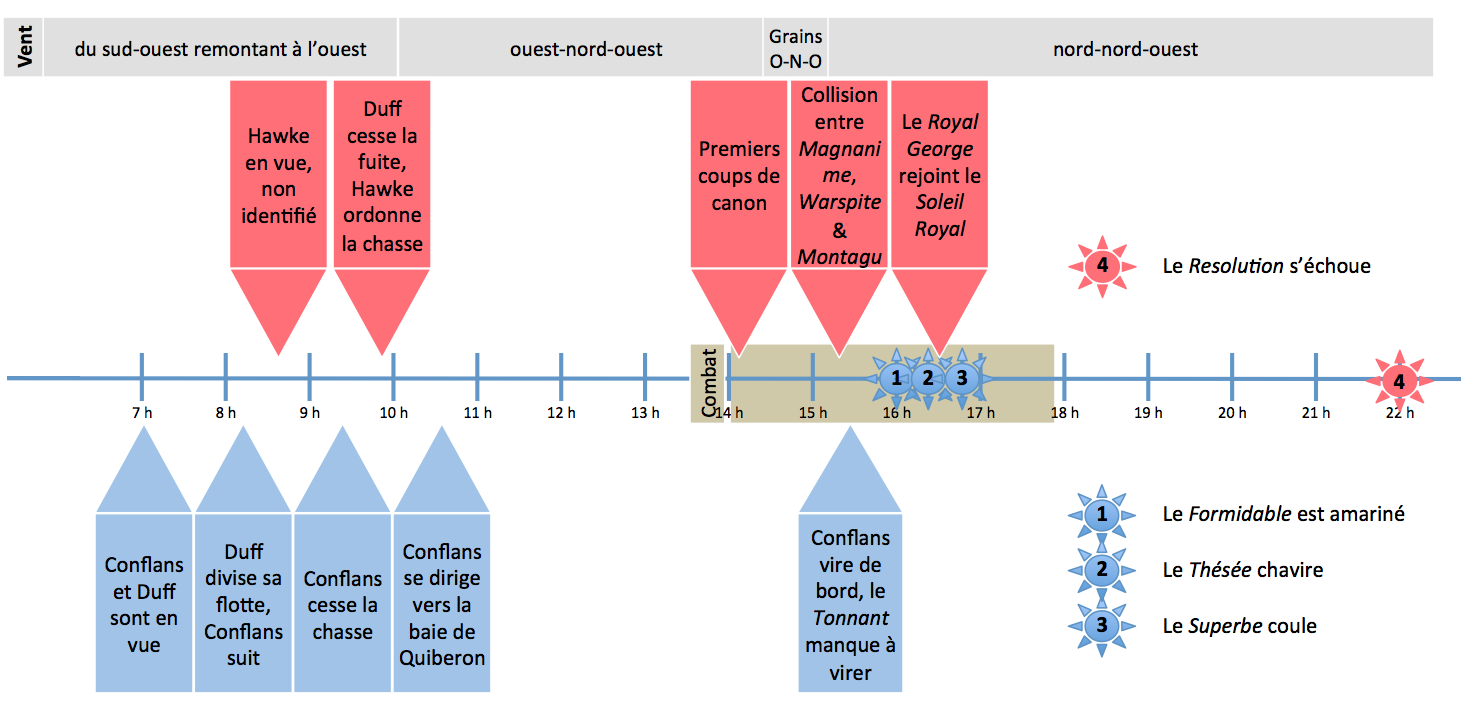
Frise chronologique de la Bataille des Cardinaux.

The battle of Quiberon Bay, 20 November 1759 title QS:P1476,en:"The battle of Quiberon Bay, 20 November 1759 "label QS:Len,"The battle of Quiberon Bay, 20 November 1759 "

Walzahn, Gravur, HMS Royal George, Commandant Admiral Hawke, Bataille des Cardinaux. Baie de Quiberon 1759
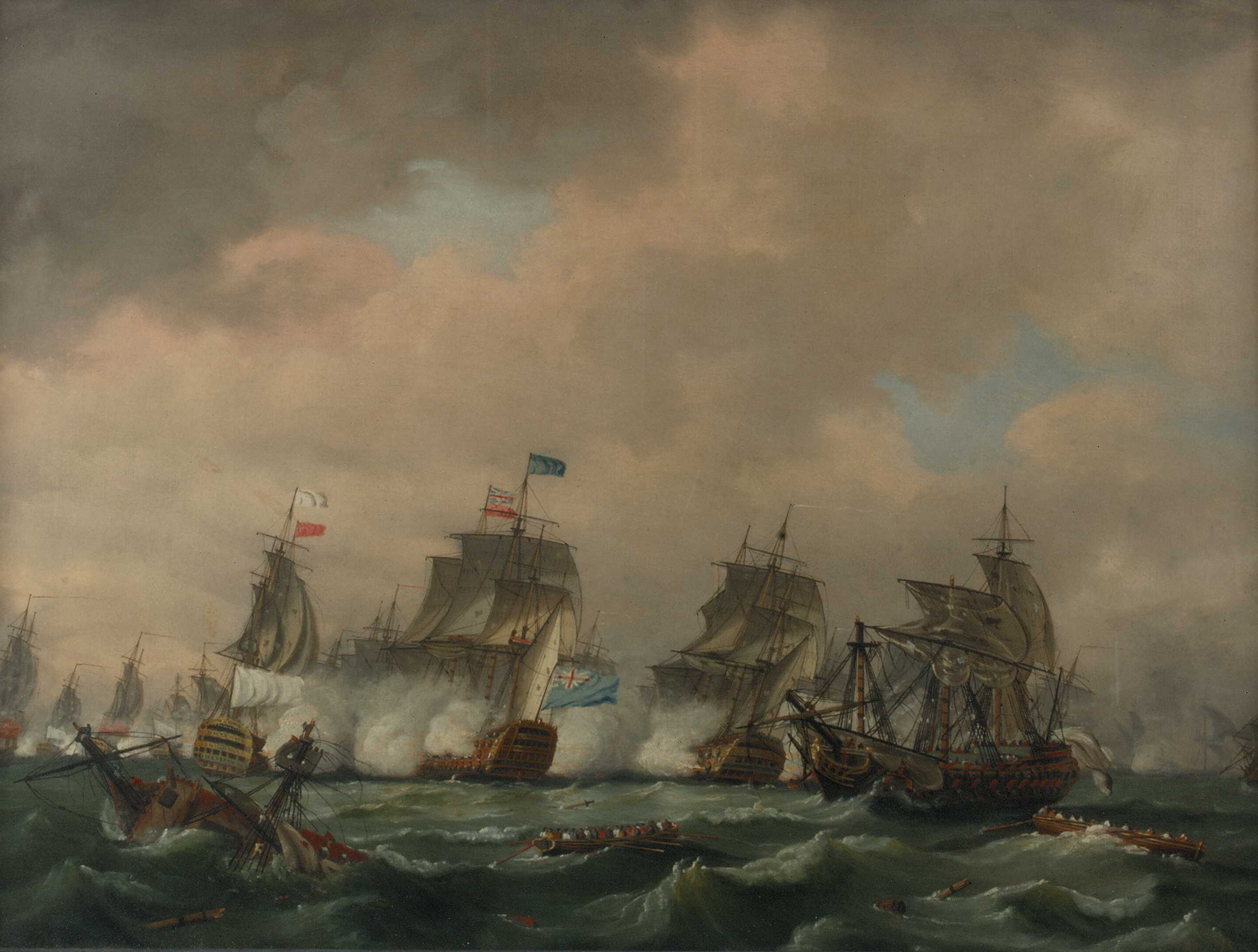
Vue générale de la bataille des Cardinaux, le 20 novembre 1759, au large des côtes bretonnes. A droite : représentation possible du vaisseau français le Héros désemparé. Plus loin au centre : les vaisseaux amiraux anglais et français au combat.

Vaisseau-amiral français le Soleil Royal à la bataille des Cardinaux, le 20 novembre1759. Guerre de Sept Ans. Détail d'un tableau anglais.

Bataille des Cardinaux. 1759. Guerre de Sept Ans. Le Soleil Royal à gauche contre le Royal George à droite. Détail d'un tableau anglais.
The French ship of the line the Superbe sinking in the Battle of Quiberon, November 20, 1759.

Monument to Admiral Edward Hawke, 1st Baron Hawke (d.1781), St Nicolas's Church, North Stoneham, Hampshire, showing the arms of Hawke (Argent, a chevron erminois between three boatswain's whistles purple), with inescutcheon of pretence of Brooke, for his heiress wife
![Monument to Admiral Lord Hawke - St Nicolas' church, North Stoneham. In 1737 he married Catherine Brooke, the only the daughter and sole heiress[1] of Walter Brooke (1695-1722)[2] of Burton Hall near Hull[3] and of Gateforth Hall[4] in Yorkshire, by his wife Catherine Hammond (d.1721) daughter and heiress of William Hammond of Scarthingwell Hall,[3] in the parish of Towton, Yorkshire.[5][6] Hawke made his home at Scarthingwell Hall and took for his barony the territorial designation "of Towton" from the parish in which it was situated.
Arms: Arms, as quartered by the descendants of Admiral Lord Hawke: Quarterly 1st and 4th argent, a chevron erminois between three boatswain's whistles purple (Hawke), 2nd and 3rd grand-quarter quarterly, 1st and 4th or, a cross engrailed gules (Brooke), 2nd and 3rd argent, a chevron engrailed sable between three mullets sable (Hammond of Scarthingwell, a Brooke heiress).](https://upload.wikimedia.org/wikipedia/commons/1/14/Monument_to_Admiral_Lord_Hawke_-_St_Nicolas_church%2C_North_Stoneham_%28geograph_2691538%29.jpg)
Monument to Admiral Lord Hawke - St Nicolas' church, North Stoneham. In 1737 he married Catherine Brooke, the only the daughter and sole heiress[1] of Walter Brooke (1695-1722)[2] of Burton Hall near Hull[3] and of Gateforth Hall[4] in Yorkshire, by his wife Catherine Hammond (d.1721) daughter and heiress of William Hammond of Scarthingwell Hall,[3] in the parish of Towton, Yorkshire.[5][6] Hawke made his home at Scarthingwell Hall and took for his barony the territorial designation "of Towton" from the parish in which it was situated. Arms: Arms, as quartered by the descendants of Admiral Lord Hawke: Quarterly 1st and 4th argent, a chevron erminois between three boatswain's whistles purple (Hawke), 2nd and 3rd grand-quarter quarterly, 1st and 4th or, a cross engrailed gules (Brooke), 2nd and 3rd argent, a chevron engrailed sable between three mullets sable (Hammond of Scarthingwell, a Brooke heiress).

Quibcardinaux
Historische Übersicht
Die Seeschlacht in der Bucht von Quiberon war eine Seeschlacht im Siebenjährigen Krieg. Sie fand am 20. November 1759 in der Bucht von Quiberon vor der Küste Frankreichs nahe St. Nazaire statt. 23 Linienschiffe unter dem britischen Admiral Sir Edward Hawke trafen auf 21 französische Linienschiffe unter Hubert de Brienne.
Fakten auf einen Blick
Royal Navy (GB)
- Befehlshaber: Edward Hawke
- Truppenstärke: 23 Linienschiffe
- Verluste: Minimal
Französische Marine
- Befehlshaber: Conflans
- Truppenstärke: 21 Linienschiffe
- Verluste: 6 Schiffe verloren
Strategischer Kontext
Britische Blockade der französischen Küste zur Vereitlung einer geplanten Invasion der britischen Inseln durch Frankreich.
Konflikt / Krieg
Siebenjähriger Krieg
Historische Orte
Die interaktive Karte erfordert die Zustimmung zu Drittanbieter-Cookies.