Muslim conquests

Age of the Caliphs Expansion under Muhammad, 622-632 Expansion during the Rashidun Caliphate, 632-661 Expansion during the Umayyad Caliphate, 661-750 Shows modern borders.

In this image, All land of Europe ever conquered and ruled by muslim is included. The yellow part is showing land ruled and the greay is other part of Europe. The orange dot is representing Micronation and yellow dot is represting Otranto, Italy
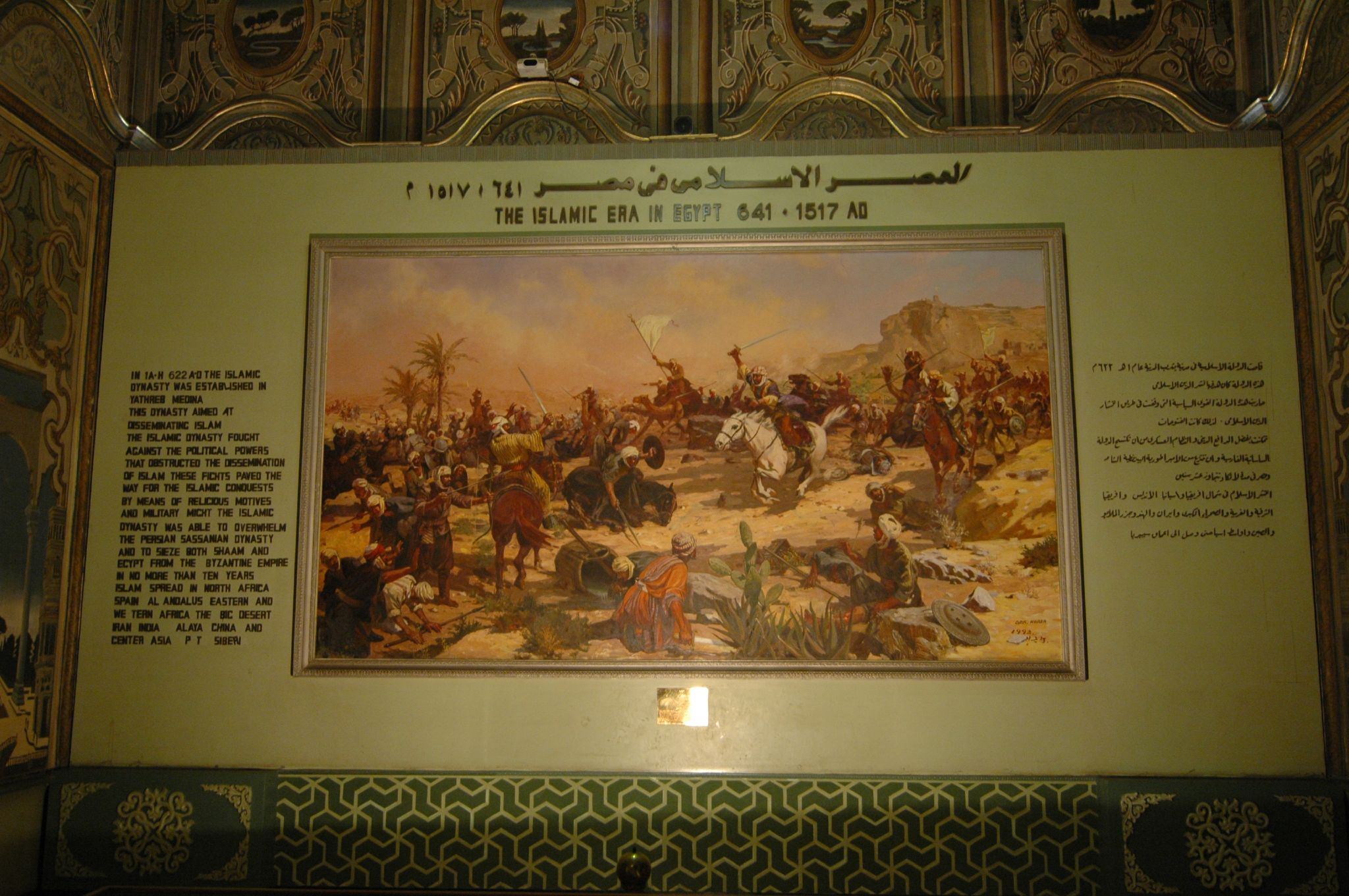
Cairo: museo militare

Islamization of India Poster

Area Under Muslim Rule at some point in history.
Historical Overview
The early Muslim conquests or early Islamic conquests, also known as the Arab conquests, were a series of religious wars initiated by Muhammad, the prophet of Islam, and continued by the early Muslims. In 622, he established the first Islamic state at Medina in Arabia, from where Muslim armies expanded rapidly under the succeeding Rashidun Caliphate and then the Umayyad Caliphate, culminating in Islamic law being extended throughout most of West Asia and North Africa, parts of South Asia and Central Asia, and parts of Mediterranean Europe over the following century. According to Scottish historian James Buchan: "In speed and extent, the first Arab conquests were matched only by those of Alexander the Great, and they were more lasting." At the height of the expansion, Muslim-ruled territory under the caliphates is estimated to have covered 13,000,000 square kilometres (5,000,000 sq mi), stretching from the Indian subcontinent in the east to the Iberian Peninsula in the west.
Key Battles
Battle of Yarmouk
636Syrien / Jordanien
Battle of al-Qadisiyyah
636Irak
Battle of Guadalete
711Spanien
Battle of Tours
732Frankreich
Outcome & Quick Facts
Outcome
Decisive Caliphate victory; permanent loss of Syria for Byzantium.
Related Literature


1177 v. Chr.: Der erste Untergang der Zivilisation

Byzanz: Die erstaunliche Geschichte eines mittelalterlichen Imperiums

Das Mittelalter: Europa von 500 bis 1500

Die Karolinger

Im Mittelalter: Handbuch für Zeitreisende

Im Rausch des Vergnügens: Eine Reise in das England von Jane Austen und Lord Byron

Militärgeschichte des Mittelalters

Nach 1177 v. Chr.: Wie Zivilisationen überleben
Der ferne Spiegel: Das dramatische 14. Jahrhundert
Barbara Tuchman