Belagerung von Tobruk

IWM caption : Australian troops occupy a front line position at Tobruk. Between April and December 1941 the Tobruk garrison, comprising British, Australian and Polish troops, was besieged by Rommel's forces. It fell to the Germans after the battle of Gazala on 21 June 1942 but was recaptured five months later. Comment : see Siege of Tobruk.

The photo's online record states that it's copyright status is 'clear'.

The British Army in North Africa 1941 A Matilda tank under camouflage netting in Tobruk, 18 November 1941.

Arrival of an Italian military convoy in Tobruch in 1941

A patrol from the Australian 2/13th Infantry Battalion, near Tobruk

Australian Forces in North Africa during the Second World War The 'Rats of Tobruk' - some of the 15,000 men of General Morshead's 9th Australian Division shelter in caves during an air raid during the siege of Tobruk. After six months besieged in the vital supply port the Australians were evacuated by sea and relieved by fresh troops. 823 men had been killed, 2214 wounded and 700 captured.

An Australian dental team working on a patient during the Siege of Tobruk, 1941

Soldiers of the Australian 2/48th Battalion man a defensive position near Tobruk in 1941

Gunners from the Australian 2/12th Field Regiment manning a captured Italian gun at Tobruk

Bardia-Sollum area, 1941
![The British offensive in Libya. Artillery shelling enemy position. Official British Army photo No. BO-667 [BM 7015].](https://upload.wikimedia.org/wikipedia/commons/1/18/British_artillery_in_Libya_cph.3b18214.jpg)
The British offensive in Libya. Artillery shelling enemy position. Official British Army photo No. BO-667 [BM 7015].
![British gunners in action in fierce Libyan fighting. A British gun team near Acroma changing its gun position. Official British Army photo No. BO-1516 [BM 14118].](https://upload.wikimedia.org/wikipedia/commons/0/03/British_gun_crew_near_Acroma_cph.3b18206.jpg)
British gunners in action in fierce Libyan fighting. A British gun team near Acroma changing its gun position. Official British Army photo No. BO-1516 [BM 14118].
!["Bath night in Tobruk". British soldier bathing. Official British Army photo No. BO-1020 [BM 9233].](https://upload.wikimedia.org/wikipedia/commons/3/37/British_soldier_taking_bath%2C_Tobruk_cph.3b18213.jpg)
"Bath night in Tobruk". British soldier bathing. Official British Army photo No. BO-1020 [BM 9233].

Czech 11thBattalion Tobruk 1941

Australian Col. F.A. Burrows (2/13th) examining a German Panzer I at Tobruk on 30 April 1941. This tank was put out of action by rifle fire as it approached the outer defences of Tobruk on a reconnaissance.
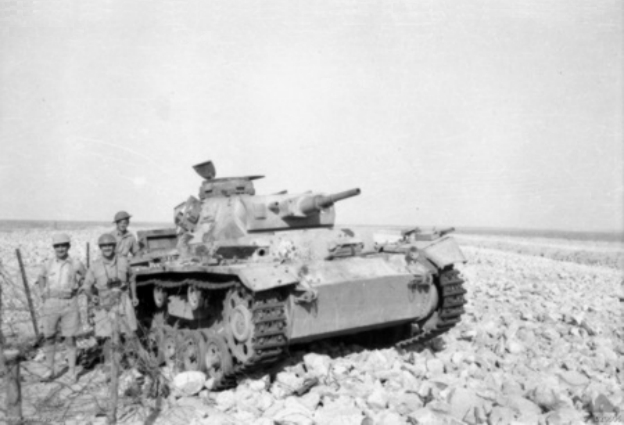
A German Panzer III Ausf.G tank destroyed during the eastern perimeter attack in the Tobruk battle, 14 September 1941.The officer with the field glasses is Lieutenant Colonel J.W. Crawford, commanding officer of the Australian 2/17th infantry battalion. On his right is Major Hodgman.

Polish Carpathian Brigade in Tobruk, gen. Sikorski's visit

German forces at the Ras el Medauar during the Siege of Tobruk
![The British offensive in Libya - battle pictures. The first prisoners, Germans, captured by troops from Tobruk seen on their way into Tobruk. Official British Army photo No. 7049 [no. BM7310].](https://upload.wikimedia.org/wikipedia/commons/0/05/German_prisoners_captured_in_the_Siege_of_Tobruk_cph.3b18194.jpg)
The British offensive in Libya - battle pictures. The first prisoners, Germans, captured by troops from Tobruk seen on their way into Tobruk. Official British Army photo No. 7049 [no. BM7310].
![The British advance in Libya. Dejected and sullen German Panzer prisoners captured during the earlier phases of the battle of Libya marching back from the forward areas en route to a prisoners-of-war camp [Tobruk]. Official British Army photo No. BO-748 [BM 7162].](https://upload.wikimedia.org/wikipedia/commons/b/b7/German_prisoners_marching_towards_Tobruk_cph.3b18205.jpg)
The British advance in Libya. Dejected and sullen German Panzer prisoners captured during the earlier phases of the battle of Libya marching back from the forward areas en route to a prisoners-of-war camp [Tobruk]. Official British Army photo No. BO-748 [BM 7162].

Italians officers, including generals Gambara and Piazzoni ,gather at Tobruk in the autumn of 1941.
![The Battle of Libya - scene around Tobruk. A bearded Italian captive gazing dejectedly into the camera while fellow captives, Fascist and Nazi, relax around him. Official British Army photo No. BO-750 [BM 7179].](https://upload.wikimedia.org/wikipedia/commons/8/8c/Italian_and_German_captives_at_Tobruk_cph.3b18211.jpg)
The Battle of Libya - scene around Tobruk. A bearded Italian captive gazing dejectedly into the camera while fellow captives, Fascist and Nazi, relax around him. Official British Army photo No. BO-750 [BM 7179].

Italian convoy heading towards North Africa
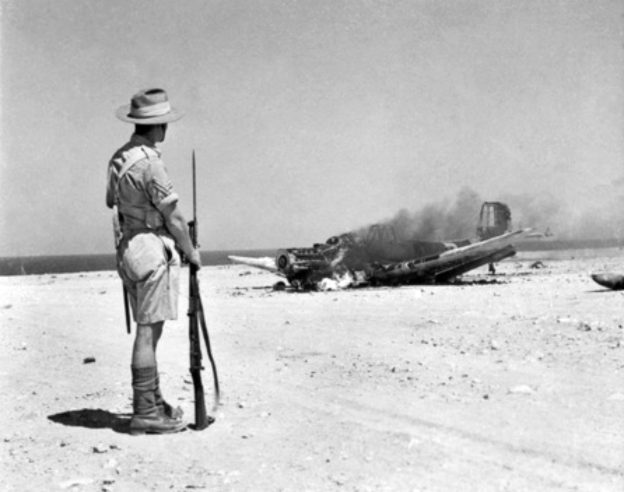
A crashed and burning German Junkers Ju 87B Stuka dive bomber near Tobruk, Libya, in 1941.

Karpac
Historische Übersicht
Monatelange Verteidigung der Hafenstadt durch "Desert Rats".
Fakten auf einen Blick
Australien (UK)
- Befehlshaber: Leslie Morshead
- Truppenstärke: 27000
- Verluste: ca. 3.800
Deutsches Afrikakorps
- Befehlshaber: Erwin Rommel
- Truppenstärke: 35000
- Verluste: ca. 12.000
Strategischer Kontext
Erhaltung eines alliierten Hafens im Rücken Rommels.
Weiterführende Literatur


Historische Orte
Die interaktive Karte erfordert die Zustimmung zu Drittanbieter-Cookies.