Schlacht von Crécy
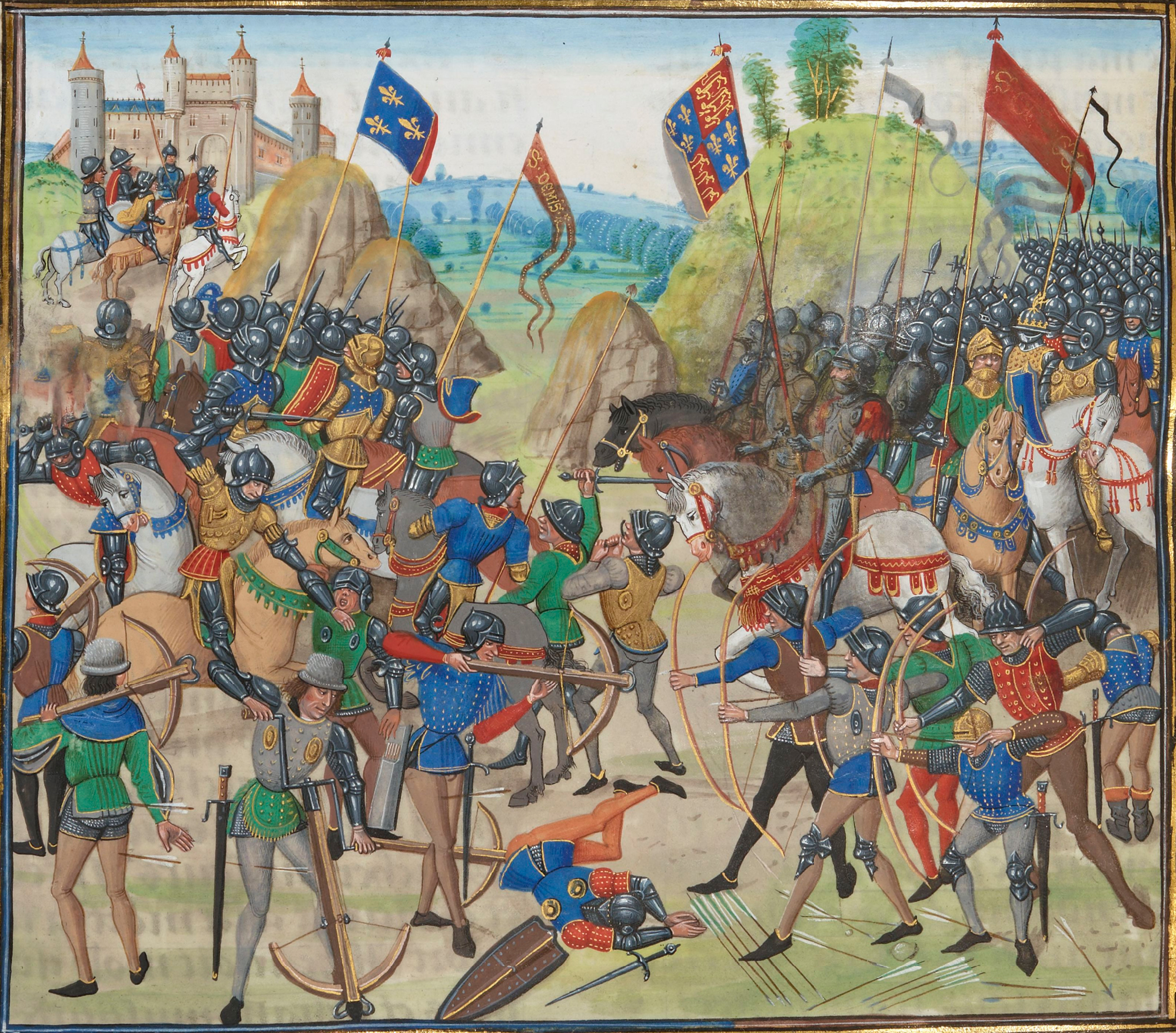
From a illuminated manuscript of Jean Froissart's Chronicles
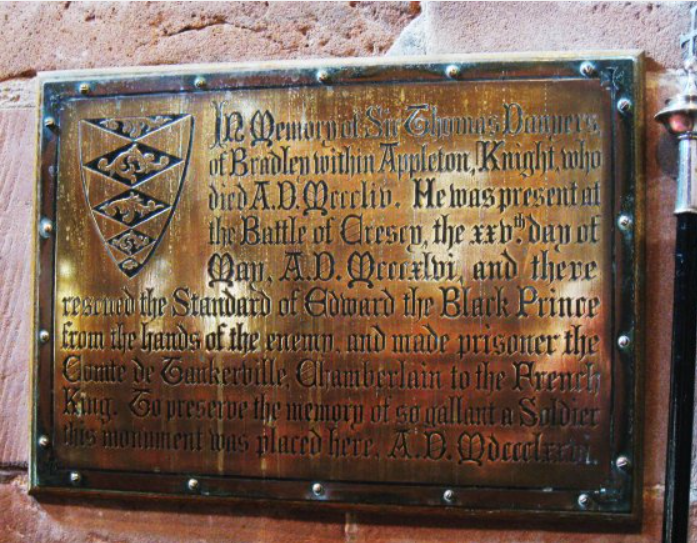
memorial brass to Sir Thomas De Anyers d.1353

English archers at the Battle of Crécy on the front lines fighting against crossbowmen, other archers and French cavalry.

Plaque with explanations about the battle of Crécy (1346), France.

Panel on the plinth of the statue of the Black Prince, City Square, Leeds, depicting a land battle, either Poitiers or Crecy, the two battles mentioned on an inscribed tablet on the plinth.

replica of a 14th century crossbow as it my be used at the Crécy battlefield

illustration from a collection of poems, this one captioned

illustration from a collection of poems

illustration from a collection of poems, this one captioned "Ah! qu'elle est belle La Marguerite" at "The Eve of Crecy"

illustration from a collection of poems, this one captioned "Ah! qu'elle est belle La Marguerite" at "The Eve of Crecy"

Kortrijk, Openbare Bibliotheek Kortrijk, Fonds Goethals-Vercruysse, cod. 135 (Tres Tractatus) f95v (miniature of the Battle of Crécy 1346)

Kortrijk, Openbare Bibliotheek Kortrijk, Fonds Goethals-Vercruysse, cod. 135 (Tres Tractatus) f95v (miniature of the Battle of Crécy 1346)
![La Normandie par M. Jules Janin, illustrée par MM Morel-Fatio, Tellier, Gigoux, Daubigny, Debon, H. Bellangé, Alfred Johannot. Paris, Ernest Bourdin, éditeur, Rue de Seine, 51.]](https://upload.wikimedia.org/wikipedia/commons/5/59/La_Normandie_Jules_Janin_illustration_82.jpg)
La Normandie par M. Jules Janin, illustrée par MM Morel-Fatio, Tellier, Gigoux, Daubigny, Debon, H. Bellangé, Alfred Johannot. Paris, Ernest Bourdin, éditeur, Rue de Seine, 51.]

Death of King John of Bohemia in Battle of Crécy (Česko-moravská kronika, 1868)

Entrée du Centre Historique Crécy la bataille
![Adres wydawniczy: Paris : E. Bourdin, 1844Opis fizyczny: [4], 652 s., [25] k. tabl. : il. ; 25 cm](https://upload.wikimedia.org/wikipedia/commons/a/a8/La_Normandie_1844_%28152385284%29.jpg)
Adres wydawniczy: Paris : E. Bourdin, 1844Opis fizyczny: [4], 652 s., [25] k. tabl. : il. ; 25 cm
Historische Übersicht
Die Schlacht bei Crécy markierte am 26. August 1346 den Anfangspunkt des Hundertjährigen Krieges auf dem europäischen Festland. In diesem Gefecht beim heutigen Ort Crécy-en-Ponthieu im Département Somme standen sich die Heere von Eduard III. von England und Philipp VI. von Frankreich gegenüber. Eduard III. errang dabei einen entscheidenden Sieg.
Fakten auf einen Blick
Angelsächsisches England
- Befehlshaber: Edward III.
- Truppenstärke: ca. 12.000
- Verluste: Gering
Königreich Frankreich
- Befehlshaber: Philipp VI.
- Truppenstärke: ca. 30.000
- Verluste: Extrem hoch
Strategischer Kontext
Englischer Rückzug nach Plünderungen; erzwungene Schlacht gegen überlegene Verfolger.
Konflikt / Krieg
Hundertjähriger Krieg
Weiterführende Literatur

A Distant Mirror: The Calamitous 14th Century
Barbara Tuchman

The Time Traveller's Guide to Medieval England: A Handbook for Visitors to the Fourteenth Century

The Time Traveller's Guide to Regency Britain: The immersive and brilliant historical guide to Regency Britain

1177 v. Chr.: Der erste Untergang der Zivilisation

Byzanz: Die erstaunliche Geschichte eines mittelalterlichen Imperiums

Das Mittelalter: Europa von 500 bis 1500


Im Mittelalter: Handbuch für Zeitreisende

Im Rausch des Vergnügens: Eine Reise in das England von Jane Austen und Lord Byron

Militärgeschichte des Mittelalters

Nach 1177 v. Chr.: Wie Zivilisationen überleben
Der ferne Spiegel: Das dramatische 14. Jahrhundert
Barbara Tuchman
Historische Orte
Die interaktive Karte erfordert die Zustimmung zu Drittanbieter-Cookies.