Schlacht von Cowpens

The Battle of Cowpens, painted by William Ranney in 1845. The scene depicts an unnamed black soldier (left) firing his pistol and saving the life of Colonel William Washington (on white horse in center).
Cowpens 1781

Taken January 14, 2006 at the Cowpens Battlefield, near en:Gaffney, South Carolina
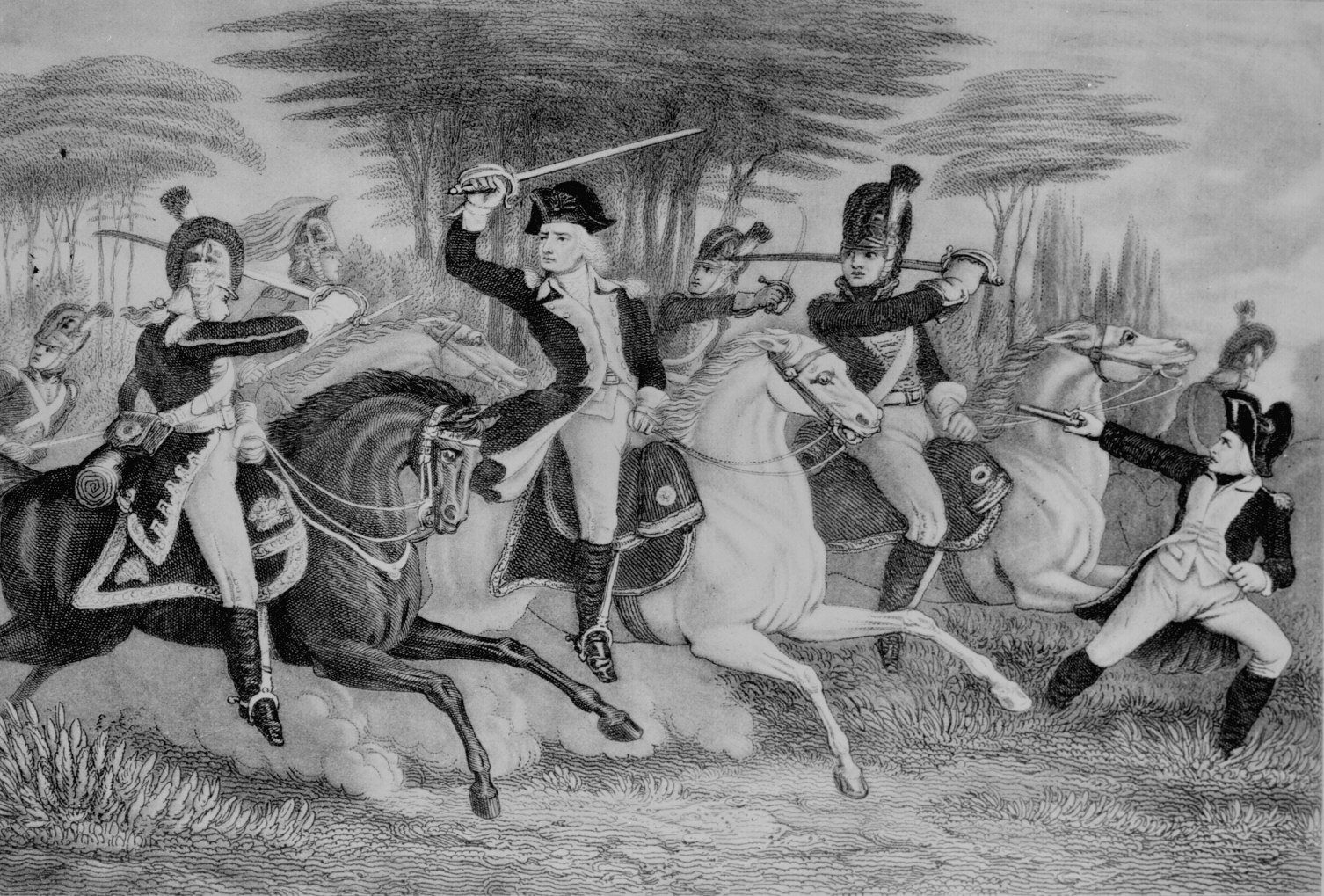
Colonel William Washington at the Battle of Cowpens
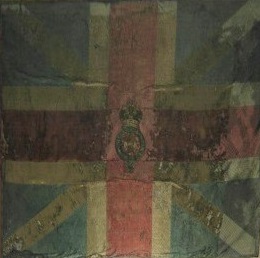
The King's colour of the 7th Regiment of Foot (Royal Fusiliers) captured at the Battle of Cowpens 17 January 1781

The Battle of Cowpens - American Attack - Second Phase
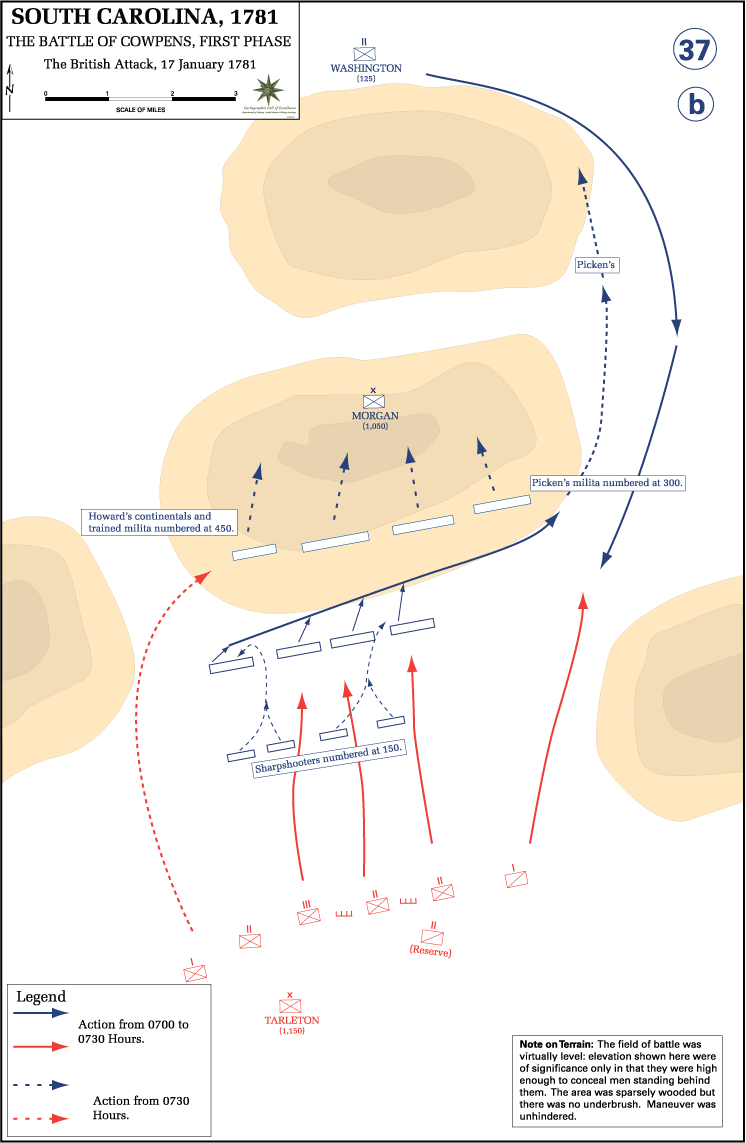
The Battle of Cowpens - British Attack - First Phase

Battle of Cowpens 17th of January/1781
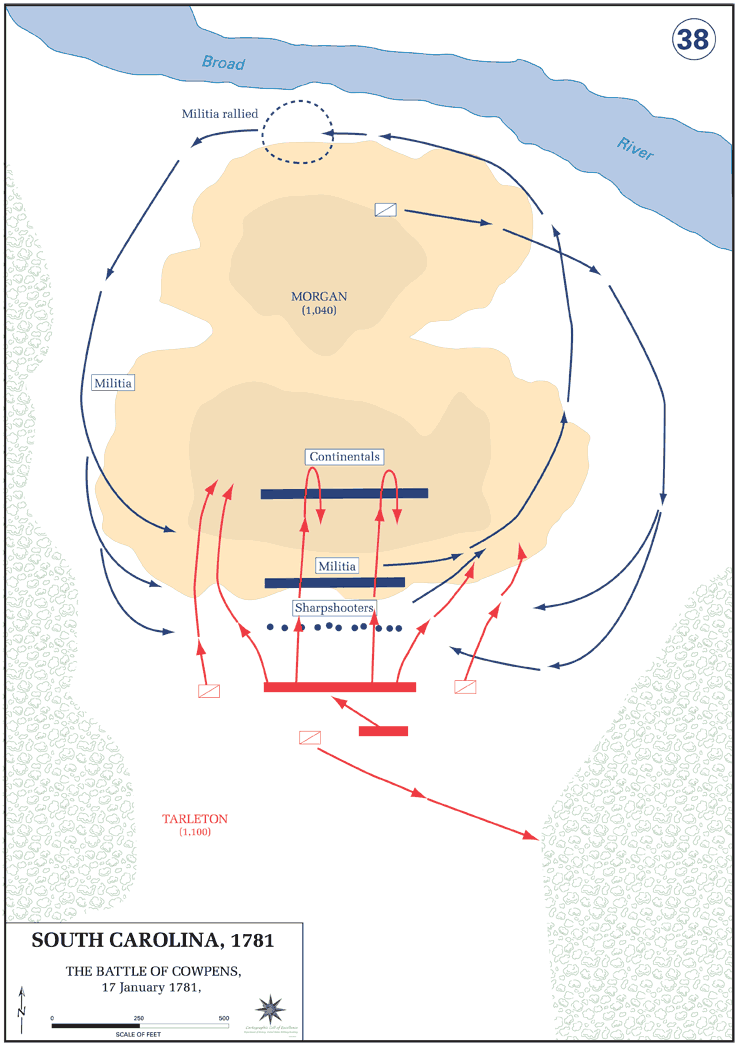
State of the Battle of Cowpens
General notes: Use War and Conflict Number 42 when ordering a reproduction or requesting information about this image.

"Colonel Tarleton" (Banastre Tarleton), illustration of poem "The Battle of the Cowpens: January 18, 1781" by Thomas Dunn English, in Harper's Monthly Magazine, January 1861.

Taken at the 225th anniversary of the Battle of Cowpens.

General Daniel Morgan, illustration of poem "The Battle of the Cowpens: January 18, 1781" by Thomas Dunn English, in Harper's Monthly Magazine, January 1861.

Battle of Cowpen

* EM15432
* EM15432

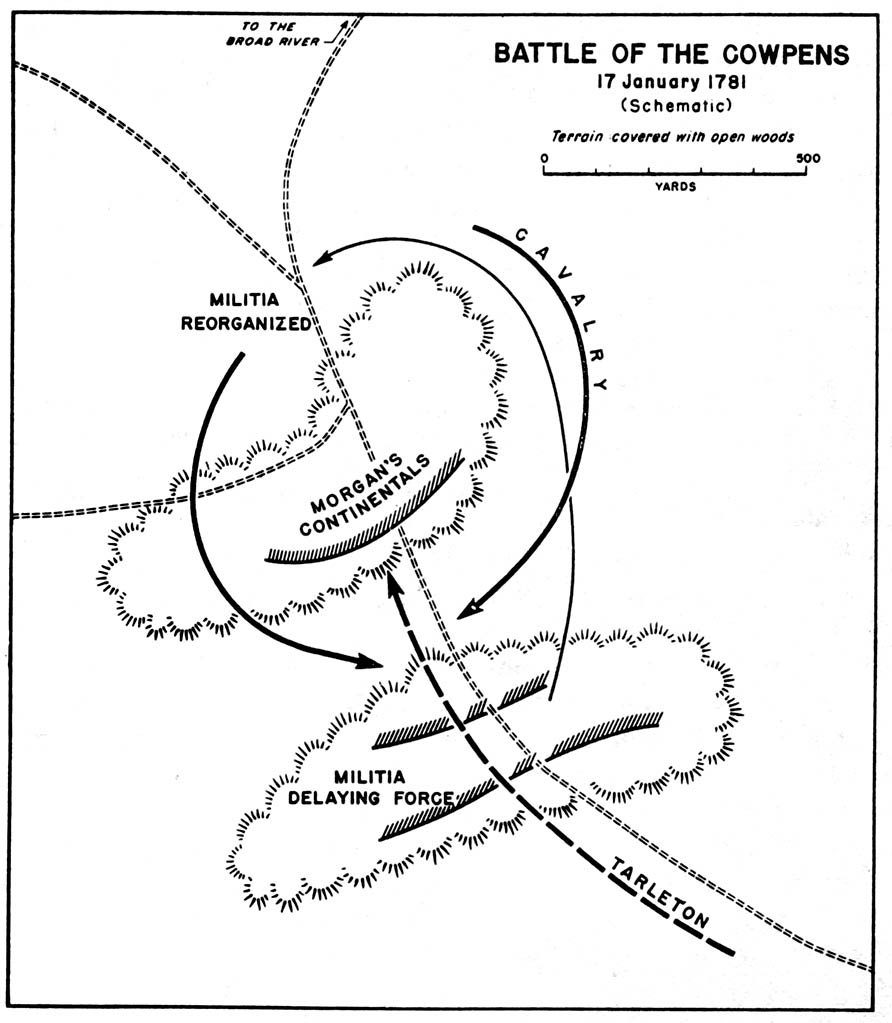
Cowpens National Battlefield or Cowpens National Battlefield Park is a unit of the National Park Service just east of Chesnee, South Carolina, not far from the North Carolina state line. Brigadier General Daniel Morgan won the Battle of Cowpens, a decisive Revolutionary War victory, here over British Lieutenant Colonel Banastre Tarleton on January 17, 1781. It is considered one of the most memorable victories of Daniel Morgan. The Battle of Cowpens (January 17, 1781) was a decisive victory by Continental army forces under Brigadier General Daniel Morgan, in the Southern campaign of the American Revolutionary War. It was a turning point in the reconquest of South Carolina from the British. en.wikipedia.org/wiki/Battle_of_Cowpens en.wikipedia.org/wiki/Cowpens_National_Battlefield en.wikipedia.org/wiki/Wikipedia:Text_of_Creative_Commons_...

"John E. Howard", illustration of poem "The Battle of the Cowpens: January 18, 1781" by Thomas Dunn English, in Harper's Monthly Magazine, January 1861.
!["Gold Medal Awarded to General [Daniel] Morgan", illustration of poem "The Battle of the Cowpens: January 18, 1781" by Thomas Dunn English, in Harper's Monthly Magazine, January 1861. Reverse drawn incorrectly: Note Roman Numeral date of 1771. The actual medal says 1781.](https://upload.wikimedia.org/wikipedia/commons/8/88/Morgan_Cowpens_medal_etching.jpg)
"Gold Medal Awarded to General [Daniel] Morgan", illustration of poem "The Battle of the Cowpens: January 18, 1781" by Thomas Dunn English, in Harper's Monthly Magazine, January 1861. Reverse drawn incorrectly: Note Roman Numeral date of 1771. The actual medal says 1781.

Title: Original flag used by 3d Md. Regiment in Battle of Cowpens made according to act. of Congress 1777 Abstract/medium: 1 negative : glass ; 5 x 7 in. or smaller
Title: Original flag used by 3d Md. Regiment in Battle of Cowpens made according to act. of Congress 1777 Abstract/medium: 1 negative : glass ; 5 x 7 in. or smaller
Contains music At head of title: 1781-1881 Prepared by William A. Courtenay, chairman of the committee Subjects: Courtenay, William Ashmead, 1831-1908; Cowpens, Battle of, Cowpens, S.C., 1781; Cowpens Monument (Spartanburg, S.C.)

The Battle of Cowpens by Don Troiani for the states of South Carolina, North Carolina, Virginia, Maryland and Delaware, 1781. Note: The Cowpens, South Carolina, January 17, 1781 -- In upland South Carolina, at a place where local farmers penned their cows, an American force of 300 Continentals and 700 militia from North and South Carolina, Virginia, and Georgia, won a brillant victory against the British. On January 16, Brigadier General Daniel Morgan, pursued by 1,100 British under Lieutenant Colonel Banastre Tarleton, carefully picked his ground for a defensive battle. That night, Morgan personally went among the Continentals and militiamen to explain his plan of battle. Morgan wanted two good volleys from the militia, who would then be free to ride away. The next day, the battle went very much as Morgan had planned. Georgia and North Carolina sharpshooters, in front of the main body of American militia, picked off British cavalrymen as they rode up the slight rise toward the Americans. Then the deadly fire of the main body of South and North Carolina militia forced Tarleton to commit his reserves. Seeing the militia withdrawing as planned, the 17th Light Dragoons pursued, but were driven off by Morgan's cavalry. Meanwhile, the British infantry, who assumed that the Americans were fleeing, were hit by the main body of Continentals, Virginia militiamen, and a company of Georgians. At the battle's end they were aided by militia troops, who, instead of riding away as planned, attacked the 71st Highlanders, who were attempting to fight their way out of the American trap. The British lost: 100 killed including 39 officers, 229 wounded, and 600 captured. As they fled the field, Tarleton and his dragoons were pursued by Colonel William Washington's cavalry, which included mounted Georgia and South Carolina militiamen. The Continentals who fought at Cowpens are perpetuated today by the 175th Infantry, Maryland ARNG, and the 198th Signal Battalion, Delaware ARNG, and the Virginia militia by the 116th Infantry, Virginia ARNG. The heritage of the rest of the American troops who fought in this greatest tactical victory ever won on American soil is carried on today by the Georgia, South Carolina and North Carolina Army National Guards.

A 425-010 U.S. Copyright Office Includes bibliographies. LC Civil War Maps (2nd ed.), 97 LeGear. Atlases of the United States, 10639 "With an introductory letter by Dwight D. Eisenhower." Available also through the Library of Congress Web site as a raster image. v. 1 (copy 3) NOS 5/9/96.
A 425-010 U.S. Copyright Office Includes bibliographies. LC Civil War Maps (2nd ed.), 97 LeGear. Atlases of the United States, 10639 "With an introductory letter by Dwight D. Eisenhower." Available also through the Library of Congress Web site as a raster image. v. 1 (copy 3) NOS 5/9/96.
!["Adapted from the West Point atlas of American wars, Volume I." Bibliography: [4] p. at end. LC Civil War Maps (2nd ed.), 97.2 LeGear. Atlases of the United States, 10682 Available also through the Library of Congress Web site as a raster image.](https://upload.wikimedia.org/wikipedia/commons/5/5c/The_West_Point_atlas_of_the_Civil_War_LOC_map62000023-16.jpg)
"Adapted from the West Point atlas of American wars, Volume I." Bibliography: [4] p. at end. LC Civil War Maps (2nd ed.), 97.2 LeGear. Atlases of the United States, 10682 Available also through the Library of Congress Web site as a raster image.
Historische Übersicht
Die Schlacht von Cowpens fand während des Amerikanischen Unabhängigkeitskrieges am 17. Januar 1781 bei Cowpens in South Carolina nahe der Grenze zu North Carolina statt. Die amerikanischen Truppen aus kontinentalen Soldaten und freiwilligen Milizen errangen einen eindeutigen Sieg gegen die britische Kolonialmacht und die einheimischen Loyalisten.
Fakten auf einen Blick
Kontinentalarmee
- Befehlshaber: Daniel Morgan
- Truppenstärke: ca. 1.900
- Verluste: ca. 150
Königreich Großbritannien
- Befehlshaber: Banastre Tarleton
- Truppenstärke: ca. 1.100
- Verluste: ca. 900 (inkl. Gefangene)
Strategischer Kontext
Entscheidungskampf im südlichen Kriegsschauplatz.
Konflikt / Krieg
Am. Unabhängigkeitskrieg
Historische Orte
Die interaktive Karte erfordert die Zustimmung zu Drittanbieter-Cookies.