Schlacht bei Hohenfriedberg

Hohenfriedeberg, Battle of Hohenfriedeberg, Attack of Prussian Infantry, June 4th, 1745 - shown "Potsdam Giants" Grenadier Guards Batallion (1806: No. 6)
After the Battle of Hohenfriedberg

Ansichtskarte von Günthersdorf, Kreis Schweidnitz Anfang des 19. Jahrhunderts.

Postcard from circa 1910date QS:P,+1910-00-00T00:00:00Z/9,P1480,Q5727902 with a photograph of Peter Janssen's mural "Hohenfriedberg, 4. Juni 1745", depicting the Battle of Hohenfriedberg, in the Ruhmeshalle Berlin

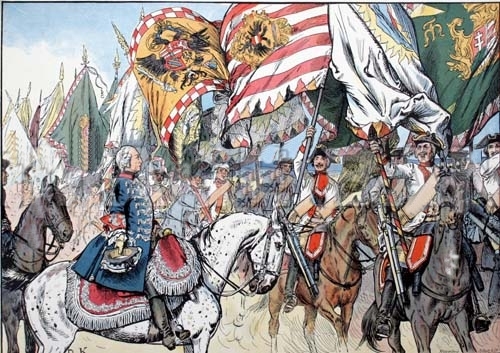
This drawing by Menzel shows the Bayreuth Dragoons in their famous charge at the Battle of Hohenfriedberg, on 4th June 1745. This was one of the most celebrated cavalry charges in history, and resulted in the capture of 2,500 Austrians and 66 flags.

The Battle of Hohenfriedeberg on June 4, 1745. Prussian Grenadier battalions beat the Saxon Guard. Carl Röchling. Military History Museum Dresden
Historische Übersicht
Die Schlacht bei Hohenfriedberg fand am 4. Juni 1745 während des Zweiten Schlesischen Krieges auf preußischem Gebiet statt.
Fakten auf einen Blick
Königreich Preußen
- Befehlshaber: Friedrich II.
- Truppenstärke: ca. 58.000
- Verluste: ca. 5.000
Österreich & Sachsen
- Befehlshaber: Karl v. Lothringen
- Truppenstärke: ca. 58.000
- Verluste: ca. 15.000
Strategischer Kontext
Verteidigung Schlesiens gegen eine massive österreichische Rückeroberungs-Offensive.
Konflikt / Krieg
Österr. Erbfolgekrieg
Historische Orte
Die interaktive Karte erfordert die Zustimmung zu Drittanbieter-Cookies.