Plünderung Roms
![French: Le sac de Rome par les barbares en 410[1]The Sack of Rome by the Barbarians in 410title QS:P1476,fr:"Le sac de Rome par les barbares en 410[1]"label QS:Lfr,"Le sac de Rome par les barbares en 410[1]"label QS:Les,"El saqueo de Roma en el año 410 por los vándalos"label QS:Lde,"Die Plünderung Roms durch die Barbaren 410"label QS:Len,"The Sack of Rome by the Barbarians in 410"label QS:Lnl,"De plundering van Rome in 410 door de Vandalen"](https://upload.wikimedia.org/wikipedia/commons/a/a0/Sack_of_Rome_by_the_Visigoths_on_24_August_410_by_JN_Sylvestre_1890.jpg)
French: Le sac de Rome par les barbares en 410[1]The Sack of Rome by the Barbarians in 410title QS:P1476,fr:"Le sac de Rome par les barbares en 410[1]"label QS:Lfr,"Le sac de Rome par les barbares en 410[1]"label QS:Les,"El saqueo de Roma en el año 410 por los vándalos"label QS:Lde,"Die Plünderung Roms durch die Barbaren 410"label QS:Len,"The Sack of Rome by the Barbarians in 410"label QS:Lnl,"De plundering van Rome in 410 door de Vandalen"

Alaric deposed (Priscus) Attalus from the throne, 410 (E. Bendemann)

Eroberung roms 410

Le Sac de Rome par Evariste-Vital Luminais. New-York, Sherpherd Gallery.

Alarich in Rom
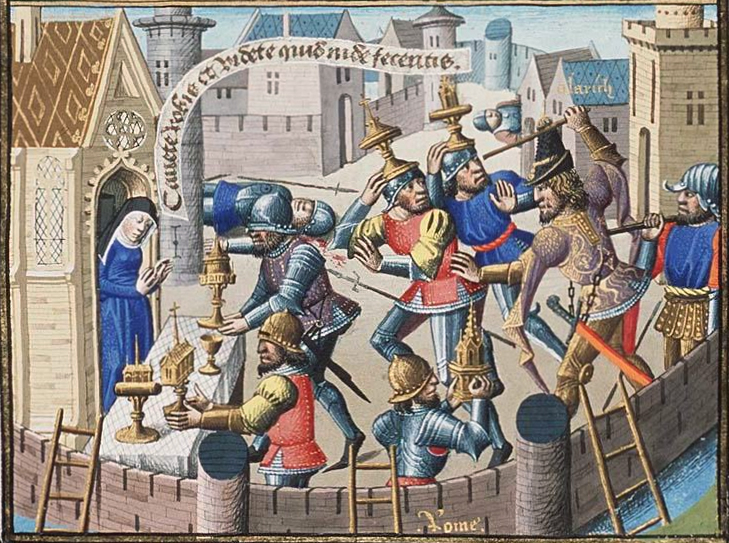
Augustine, La Cité de Dieu (Vol. I). Translation from the Latin by Raoul de Presles: Sack of Rome by Alaric - sacred vessels are brought to a church for safety (2nd of 2 images). Place of origin, date: Paris, Maïtre François (illuminator); c. 1475; 1478-1480 Material: Vellum, ff. 467, 440x300 (270x185) mm, 46 lines, littera hybrida, Binding: 18th-century brown leather (c. 1769) Decoration: 11 two-column miniatures (257/204x190/177 mm); 277 column miniatures (c. 120x80 mm); 11 illustrations in the margin (coats of arms); decorated initials with border decoration Provenance: made for Jacques d'Armagnac, duke of Nemours (1433-1477) and after his capture continued for Philippe de Commines (1447-1511), lord of Argenton (coats of arms in margin and on edge). Purchased in 1751 at the sale of J.-A. Crozat de Tugny (1696-1751) at Thiboust, Paris,by L.-J. Gaignat of Paris; purchased in 1769 at the Gaignat sale at G.F. De Bure le Jeune, Paris (cat. 1 Febr., no. 242) by Gerard Meerman (1722-1771) of Rotterdam, later The Hague; by descent to his son Johan Meerman (1753-1815); acquired between 1816 and 1824 by Willem H.J vanWestreenen van Tiellandt (1783-1848) of The Hague; by legacy to the kingdom of the Netherlands Annotation: Vol. II now: Nantes, BM, fr. 8

Siege of Rome by Alaric I, 410
Historische Übersicht
Die Plünderung Roms durch überwiegend westgotische Krieger unter Alarich erfolgte vom 24. bis zum 27. August 410. Dies war die erste Einnahme Roms seit dem Einfall der Kelten rund 800 Jahre zuvor. Das Ereignis bedeutete einen auch von Zeitgenossen wie Hieronymus, Augustinus und Orosius intensiv diskutierten Einschnitt in der Geschichte Roms. Das Geschehen erschütterte das Vertrauen in die weströmische Regierung tief und die Plünderung beschleunigte den Abstieg der Stadt Rom, die bereits seit fast einem Jahrhundert keine ständige Kaiserresidenz mehr war.
Fakten auf einen Blick
Westgoten
- Befehlshaber: Alarich I.
- Truppenstärke: ca. 40.000 Mann
- Verluste: Gering
Weströmisches Reich
- Befehlshaber: Kaiser Honorius (in Ravenna)
- Truppenstärke: ca. 5.000 (Stadtgarde)
- Verluste: Hoch (Zivilbevölkerung)
Strategischer Kontext
Ultimatives Druckmittel Alarichs nach gescheiterten Verhandlungen über Landzuweisungen und Zahlungen.
Konflikt / Krieg
Gotenkriege
Weiterführende Literatur

Geschichte der Spätantike: Das Römische Reich von Diocletian bis Justinian 284-565 n. Chr.
Historische Orte
Die interaktive Karte erfordert die Zustimmung zu Drittanbieter-Cookies.