Gefechte von Lexington & Concord

Buckman Tavern, Lexington, MA

A view of Concord Massachusetts by Timothy Martin Minot.
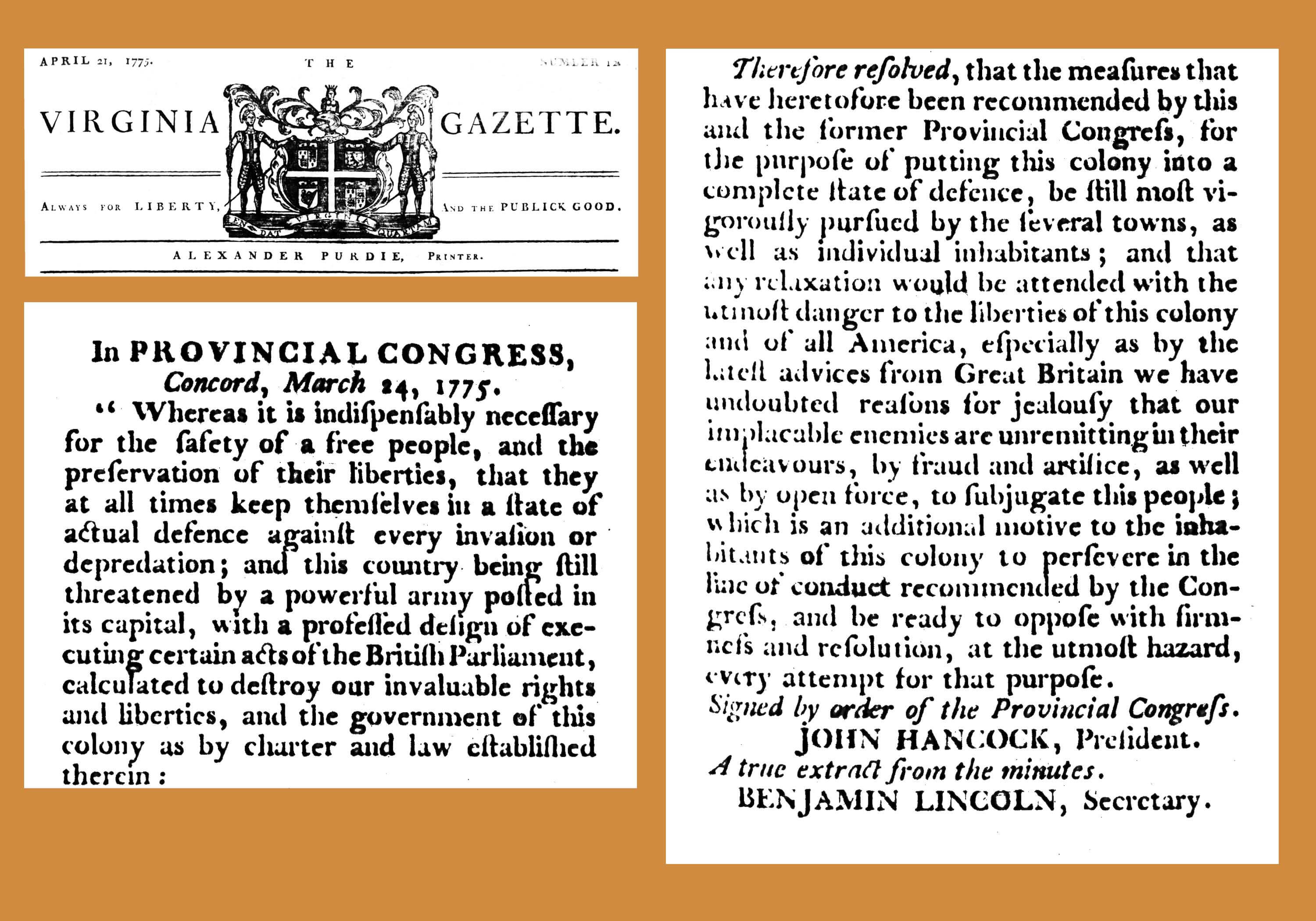
Resolution of the Massachusetts Provincial Congress of March 24, 1775, signed by its president John Hancock, as printed in The Virginia Gazette (Williamsburg, Virginia) on April 21, 1775. Full text: IN PROVINCIAL CONGRESS Concord, March 24, 1775 Whereas it is indispensably necessary for the safety of a free people, and the preservation of their liberties, that they at all times keep themselves in a state of actual defence against every invasion or depredation; and this country being still threatened by a powerful army posted in its capital, with a professed design of executing certain acts of the British Parliament, calculated to destroy our invaluable rights and liberties, and the government of this colony as by charter and law established therein: Therefore resolved, that the measures that have heretofore been recommended by this and the former Provincial Congress, for the purpose of putting this colony into a complete state of defence, be still most vigorously pursued by the several towns, as well as individual inhabitants; and that any relaxation would be attended with the utmost danger to the liberties of this colony and of all America, especially as by the latest advices from Great Britain we have undoubted reasons for jealousy that our implacable enemies are unremitting in their endeavours, by fraud and artifice, as well as by open force, to subjugate this people; which is an additional motive to the inhabitants of this colony to persevere in the line of conduct recommended by the Congress, and be ready to oppose with firmness and resolution at the utmost hazard, every attempt for that purpose. Signed by order of the Provincial Congress. JOHN HANCOCK, President. A true extract from the minutes. BENJAMIN LINCOLN, Secretary.

Newspaper entries surrounding John Hancock's summoning the Massachusetts Provincial Congress in a time of growing conflict between England and its American colonies (The Maryland Gazette, published April 20, 1775 in Annapolis, Maryland, U.S.)

Early reports of the Battles of Lexington and Concord, as published in The Maryland Gazette (Annapolis, Maryland, U.S.) on April 27, 1775.

Battle of Lexington

This item is a photograph of a sign describing the battle at the North Bridge in Concord, Massachusetts.
!["Plate IV. A view of the south part of Lexington." In: "The Doolittle engravings of the battles of Lexington and Concord in 1775"
Hand colored engraving. Published 1775. Amos Doolittle (engraver) and Ralph Earl (artist).
A View of the South Part of Lexington (Plate IV) shows the regulars in action as they returned to Lexington after the engagement on Concord Bridge. It was there that they met the relief column from Boston headed by Hugh, Earl Percy. Minutemen can be seen in the foreground firing behind walls as British soldiers attempt to defend the column as it marched through the withering gauntlet. Several houses sit ablaze in the background, torched presumably to deny snipers safe perches. As in Plate II, Doolittle has added identifying numbers which are captioned below the image: "1. Colonel Smith's Brigade retreating before the Provincials. 2. Earl Piercys [sic] Brigade meeting them. 3 & 4. Earl Percey & Col. Smith. 5. Provincials. 6 & 7. The Flanck-guards of Piercys Brigade. 8. A Field-piece pointed at the Lexington Me[e]tinghouse. 9. The Burning of the Houses in Lexington."](https://upload.wikimedia.org/wikipedia/commons/4/4e/A_View_of_the_South_Part_of_Lexington_2022_NYR_19907_0338.jpg)
"Plate IV. A view of the south part of Lexington." In: "The Doolittle engravings of the battles of Lexington and Concord in 1775" Hand colored engraving. Published 1775. Amos Doolittle (engraver) and Ralph Earl (artist). A View of the South Part of Lexington (Plate IV) shows the regulars in action as they returned to Lexington after the engagement on Concord Bridge. It was there that they met the relief column from Boston headed by Hugh, Earl Percy. Minutemen can be seen in the foreground firing behind walls as British soldiers attempt to defend the column as it marched through the withering gauntlet. Several houses sit ablaze in the background, torched presumably to deny snipers safe perches. As in Plate II, Doolittle has added identifying numbers which are captioned below the image: "1. Colonel Smith's Brigade retreating before the Provincials. 2. Earl Piercys [sic] Brigade meeting them. 3 & 4. Earl Percey & Col. Smith. 5. Provincials. 6 & 7. The Flanck-guards of Piercys Brigade. 8. A Field-piece pointed at the Lexington Me[e]tinghouse. 9. The Burning of the Houses in Lexington."
![A View of the Town of Concord
titled, "A View of the Town of Concord" (Plate II) shows British columns marching into Concord on 19 April 1775 following the short action on Lexington Green earlier in the day. Several detachments can be seen in the background including a small group rolling out barrels of powder and dumping them in the mill pond (upper left). In the foreground, Colonel Smith and Major Pitcairn are reconnoitering with a spyglass. Below, captions identify various pieces of the action: "1. Companies of the Regulars marching into Concord. 2. Companies of Regulars drawn up in order. 3. A Detaichment destroying the Provincal[']s Stores. 4 & 5 Colonel Smith & Major Pitcairn viewing the Provincials who were mustering on an East Hill in Concord 6. The Townhouse. 7 the Meetinghouse —"
The British Army in Concord, April 19, 1775. "Plate II. A view of the town of Concord." In: "The Doolittle engravings of the battles of Lexington and Concord in 1775."](https://upload.wikimedia.org/wikipedia/commons/2/2f/A_View_of_the_Town_of_Concord_2022_NYR_19907_0338.jpg)
A View of the Town of Concord titled, "A View of the Town of Concord" (Plate II) shows British columns marching into Concord on 19 April 1775 following the short action on Lexington Green earlier in the day. Several detachments can be seen in the background including a small group rolling out barrels of powder and dumping them in the mill pond (upper left). In the foreground, Colonel Smith and Major Pitcairn are reconnoitering with a spyglass. Below, captions identify various pieces of the action: "1. Companies of the Regulars marching into Concord. 2. Companies of Regulars drawn up in order. 3. A Detaichment destroying the Provincal[']s Stores. 4 & 5 Colonel Smith & Major Pitcairn viewing the Provincials who were mustering on an East Hill in Concord 6. The Townhouse. 7 the Meetinghouse —" The British Army in Concord, April 19, 1775. "Plate II. A view of the town of Concord." In: "The Doolittle engravings of the battles of Lexington and Concord in 1775."

Acton alarm

Monument commemorating Amos and Kezia Kendall Wyman feeding and housing Samuel Adams and John Hancock at their home on April 19, 1775. Hancock and Adams escaped possible capture by British soldiers the night Paul Revere rode and the beginning of the American Revolution. John Hancock later sent Kezia a cow in appreciation for her hospitality. A large gift for a small farmer.
Stokes 1775-B-90 Print depicts April 19, 1775. Deák 141

"Journée de Lexington". Battle of Lexington by French engraver Nicolas Ponce (1746-1831) after François Godefroy (1743?-1819). Illustration from Nicolas Ponce, "Recueil d'estampes representant les différents événemens de la Guerre qui a procuré l'indépendance aux Etats-Unis de l'Amérique", Ponce et Godefroy, Paris, 1784?

Cropped version of image at right. The battle of Lexington, April 19th. 1775. Plate I." In: "The Doolittle engravings of the battles of Lexington and Concord in 1775."

Cropped version of File:Battleoflexingtonengraving.jpg. Engraving of the Battle of Lexington in 1775

Title: Battle of Lexington Physical description: 1 print. Notes: This record contains unverified data from PGA shelflist card.; Associated name on shelflist card: Unattributed.

Title: Battle of Lexington Physical description: 1 print. Notes: This record contains unverified data from PGA shelflist card.; Forms part of: Popular graphic art print filing series (Library of Congress).; Title from item.

Title: Battle of Lexington Abstract: Print shows Minute Men firing on the British in Lexington, Massachusetts. Physical description: 1 print : engraving ; 39.8 x 51.8 cm. (sheet, trimmed within platemark) Notes: Published in: Viewpoints; a selection from the pictorial collections of the Library of Congress .... Washington : Library of Congress ..., 1975, no. 64.; Exhibited: "Creating the United States," the Library of Congress, Washington, D.C., 2011-2012.; Exhibited: "Revere's Ride and Longfellow's Legend" at the Brandywine River Museum, Chadds Ford, PA, 2004-2005.; E. Tisdale delt. ; C. Tiebout sculpt.; Title from item.

A stylized engraving that inaccurately depicts the Battle of Lexington, 19 April 1775.
General notes: Use War and Conflict Number 10 when ordering a reproduction or requesting information about this image.

"Battle of Lexington" - British troops fire on colonists, who had gathered at Lexington to stop them from going on to Concord to destroy a colonial supply depot. Major Pitcairn, the British officer on horseback, had ordered the colonists to disarm and disperse. As they began to do so, a single shot was fired, which led to an exchange of fire between a British platoon and the colonial militia. Eight militiamen were killed and ten wounded before Pitcairn regained control of his troops. Thus the American Revolution started, with "the shot heard round the world."

Engraving of the Battle of Lexington in 1775

Bureau of Engraving and Printing engraved vignette from the Battle of Lexington, based on a Darley drawing. The vignette appears on the left obverse of the $20 National Bank Note. Engraving by Luigi (Louis) Delnoce.Scanned from an original impression, part of a Treasury Department presentation album of portraits and vignettes (c. 1902), possibly presented to Lyman Gage. (Epson 10000XL scanner @2400dpi).

Broadside printed by Mary Katharine Goddard in 1775 in Baltimore.
Historische Übersicht
Die Gefechte von Lexington und Concord waren die ersten Kämpfe des Amerikanischen Unabhängigkeitskriegs. Sie wurden am 19. April 1775 in den Orten Lexington, Concord, Lincoln, Menotomy und Cambridge in Massachusetts ausgetragen. Die Gefechte markieren den Beginn des bewaffneten Konflikts zwischen Großbritannien und den dreizehn Kolonien.
Fakten auf einen Blick
Amerikanische Miliz
- Befehlshaber: Parker / Barrett
- Truppenstärke: ca. 3.800
- Verluste: ca. 95
Königreich Großbritannien
- Befehlshaber: Francis Smith
- Truppenstärke: ca. 1.500
- Verluste: ca. 270
Strategischer Kontext
Britischer Versuch, ein Waffenlager der Milizen auszuheben und Rebellenführer zu verhaften.
Konflikt / Krieg
Am. Unabhängigkeitskrieg
Historische Orte
Die interaktive Karte erfordert die Zustimmung zu Drittanbieter-Cookies.