Schlacht um Alesia

Engraving depicting an episode of the battle of Alesia
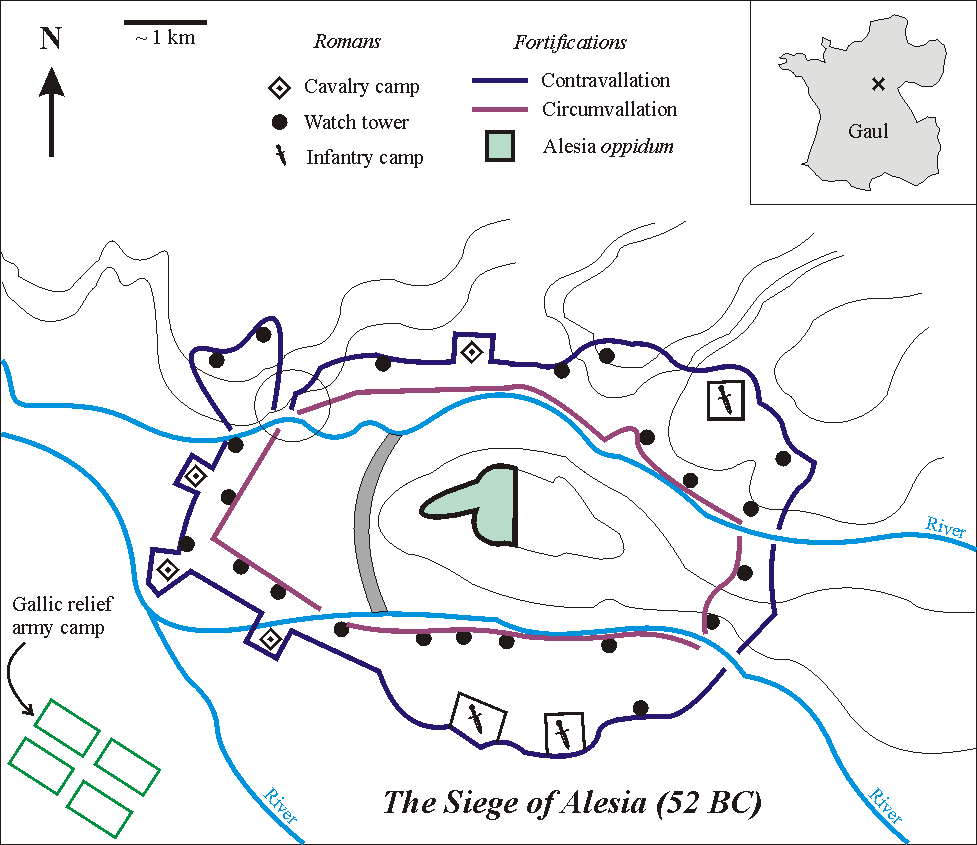
Sketch of the Battle of Alesia, drawn by Muriel Gottrop in December 2004. Inbox: cross shows location of Alesia in Gaul (modern France). The open circle shows the weakness in the contravallation line

No description

Alise-Sainte-Reine (Côte-d'Or, France) - View from the Alesia museum : the Alesia plain, where the main fightings of the Alesia battle are believed to have taken place

Alise-Sainte-Reine (Côte-d'Or, France) - View from the Alesia museum : the Auxois hill, where the Gallic oppidum of Alesia took place

vercingétorix

Mappa della battaglia di Alesia del 52 a.C.

Mappa delle fortificazioni di Cesare ad Alesia del 52 a.C.

Battle of Alesia (Caesarː A History Of The Art Of War Among The Romans Down To The End, vol. I, 1892)

Battle of Alesia in 52 BC (engraving)

Carte établie vers 1755 par Jean-Baptiste Bourguignon d'Anville, extraite d'une édition d'époque de La Guerre des Gaules. Dimensions dépliée : 35,5 x 23,5 cm. Collection privée.

C. Giulio Cesare, La guerra gallica, traduzione di Eugenio Giovannetti, Firenze, Le Monnier, 1939

no caption

No description

Le fortificazioni di Cesare ad Alesia del 52 a.C.
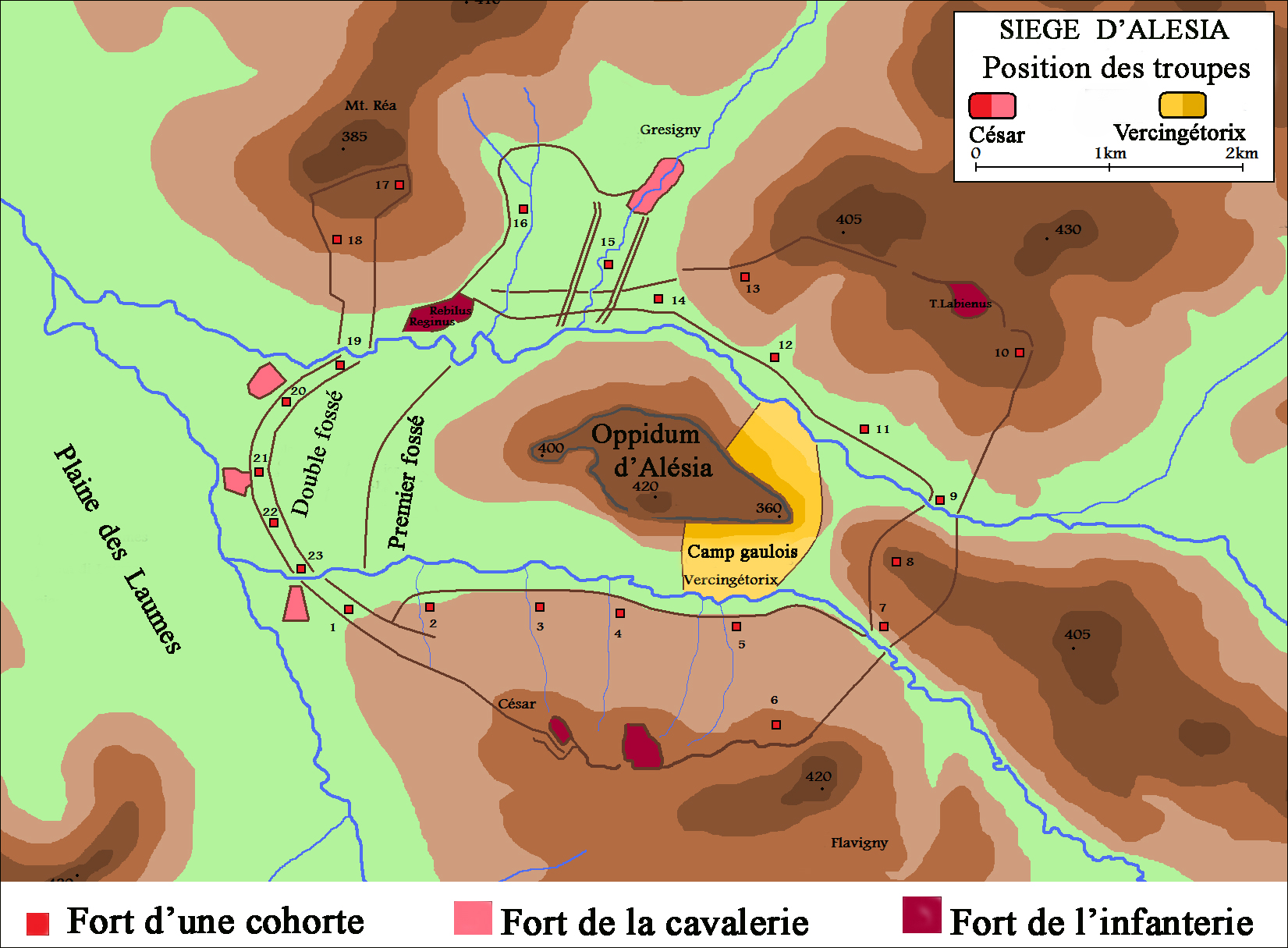
Plan du siège d’Alésia en 52 avant notre ère. Les positions des troupes et le réseau hydrographique autour de l’oppidum.

Römische Kavallerielager in Alesia, südöstlich des Museums am Südwestende der Befestigungslagen von Gaius Julius Cäsar um den Ort

No description

German Translation of SiegeAlesia.jpg Zeichnung der Belagerung im Krieg von Alesia, gezeichnet von Muriel Gottrop im Dezember 2004. Box: Die Lage von Alesia in Gallien (heute Frankreich). Übersetzung von Raphael Michel (Dezember 08)

Sketch of the Battle of Alesia (Portuguese version), drawn by Muriel Gottrop in December 2004.

Siège d'Alésia par César contre Vercingétorix en 52 av. J.-C.

Venarey-les-Laumes (Côte-d'Or, France) - Les Laumes-Alésia train station - Plaque on the facade, commemorating the 2000th anniversary of the battle of Alesia
Historische Übersicht
Die Schlacht um Alesia war die Entscheidungsschlacht im Spätsommer 52 v. Chr. zwischen dem römischen Feldherrn Gaius Iulius Caesar und den Galliern (Kelten) unter Führung des Vercingetorix. Sieger der Auseinandersetzung war Caesar, der damit die römische Herrschaft in Gallien für Jahrhunderte festigte.
Fakten auf einen Blick
Römische Republik
- Befehlshaber: Julius Caesar
- Truppenstärke: ca. 50.000 Legionäre / 10.000 Germanen
- Verluste: ca. 2.000
Gallische Koalition
- Befehlshaber: Vercingetorix
- Truppenstärke: ca. 80.000 (in Alesia) / 250.000 (Entsatz)
- Verluste: Enorm hoch / Totale Auflösung
Strategischer Kontext
Finale Entscheidung über das Schicksal Galliens. Vercingetorix wurde eingekesselt, um den gallischen Widerstand endgültig zu brechen.
Konflikt / Krieg
Gallischer Krieg
Weiterführende Literatur

GOLDSWORTHY:ROMAN ARMY AT WAR 100BC-AD200

Auf dem Weg zum Imperium: Eine Geschichte der römischen Armee

Aufstieg und Fall des Alten Ägypten: Die Geschichte einer geheimnisvollen Zivilisation vom 5. Jahrtausend v. Chr. bis Kleopatra


Das alte Griechenland: Die visuelle Geschichte. Hochwertiger Bildband mit über 850 Fotos

Das frühe Persien: Geschichte eines antiken Weltreichs

Die verdammt blutige Geschichte der Antike: ohne den ganzen langweiligen Kram

Eine unerzählte Geschichte der Antike: Auf den Spuren vergessener Orte – von Britannia bis Vietnam

Feldherren, Krieger und Strategen: Krieg in der Antike von Achill bis Attila

Geschichte der römischen Kaiserzeit: Von Augustus bis zu Konstantin

Geschichte der römischen Republik: Von den Anfängen bis Augustus

Gladius: Roms Legionen in Germanien

Krise und Untergang der römischen Republik


Römische Geschichte: 5 Bände im Schuber

Römische Geschichte: Von den Anfängen bis zum Untergang

Über die Germanen: Tacitus – antike Geschichtsschreibung über die Bewohner Germaniens
Historische Orte
Die interaktive Karte erfordert die Zustimmung zu Drittanbieter-Cookies.