Second Sino-Japanese War
, Flak Light at ChongqingChina. Picture from the archive of Mission Covenant Church of Sweden.

1945年8月16日重慶《掃蕩報》
China. Picture from the archive of Mission Covenant Church of Sweden.
China. Picture from the archive of Mission Covenant Church of Sweden.

Japanese Occupation of China in 1940. Translated back to English from the Spanish svg.

"China--First to Fight

Second Sino-Japanese War–related collections in the Capital Museum

Pillbox 2, Dapan Mountain

208-PU-171-F-21: Washington, D.C. Letter to the Japanese Ambassador, December 13, 1937, signed by President Franklin D. Roosevelt detailing the displeasure of bombing of American and other non-Chinese vessels at Yangtse.Office of War Information Collection. (2016/08/30).

AFTER THE SACK OF CANTON. Is China mad

Lot 11614-20: Second Sino-Japanese War, July 1937-September 1945. American officers instructing Chinese task forces on the India mission. Colonel R.M. Sandusky, standing left forward, and Lieutenant William E. Schmertz, instructor, and General Lee of Chinese General Headquarters, observe as General Lo peers through the sight on a 60mm mortar somewhere in India, 1943. Office of War Information Photograph, 16777-ZC. (2016/01/22).

Announcement about national bonds selling in Taiwan, 1944.

Anti-Japanese Muslim guerillas in Northwest China, c. 1939.

Armed training of Japanese settler women in Manchukuo (Manchuria) ar. 1930s

"This foreign person has come to China to help in the war effort. Soldiers and civilians, one and all, should rescue, protect, and provide him with medical care."

"This foreign person has come to China to help in the war effort. Soldiers and civilians, one and all, should rescue, protect, and provide him with medical care." The text more precisely say "American Air Force come to China to help in fighting, respect my military and civilians aid" 美國空軍來華助戰仰我軍民一體救護)

48-star US flag, with multilingual inscriptions below: "This foreign person has come to China to help in the war effort. Soldiers and civilians, one and all, should rescue, protect, and provide him with medical care."
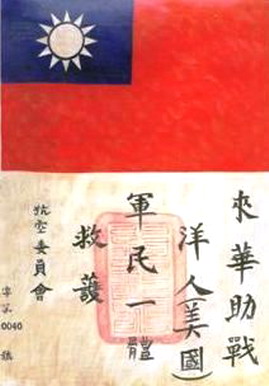
"This foreign person has come to China to help in the war effort. Soldiers and civilians, one and all, should rescue, protect, and provide him with medical care."

"This foreign person has come to China to help in the war effort. Soldiers and civilians, one and all, should rescue, protect, and provide him with medical care."

Blood chit was used by US pilots fighting in China, in case when they were shot down by the Japanese. CA-114 depicts a farmer bringing an American pilot into his hut as a smiling wife prepares a meal. The text on the front is, Americans will never forget the people who helped them. At the lower left a blood chit is shown in full color with the text, Recognize the American flag.

This leaflet depicts an American aviator opening his flight jacket to show a Chinese farmer his "blood chit" in the form of an American flag. Text on the front is: Plant melons and harvest melons, plant peas and harvest peas. This is similar to the Biblical proverb: As ye sow shall you reap. Text on the back explains that by doing the simple good deed of returning an American pilot to friendly forces the civilians will be richly rewarded. In addition, text at the bottom of the leaflet is: Please notice this symbol with an arrow pointing to the China-Burma-India (CBI) Theater of War insignia.

Blood chit was used by US pilots fighting in China, in case when they were shot down by the Japanese. This leaflet to the Chinese depicts an American aviator being carried in a sling by two Chinese civilians. Symbols of the American Air Force and the (CBI) are depicted in full color with the text, "Identify clearly these American military insignia." Text on the front is once again, "Plant melons and harvest melons, plant peas and harvest peas," a Chinese proverb equivalent to "As you sow so shall you reap."

"This foreign person has come to China to help in the war effort. Soldiers and civilians, one and all, should rescue, protect, and provide him with medical care."

Bringing up a field gun: Shanhaikwan front. Why China sees red

British blue-jackets guarding the Customs House. Why China sees red
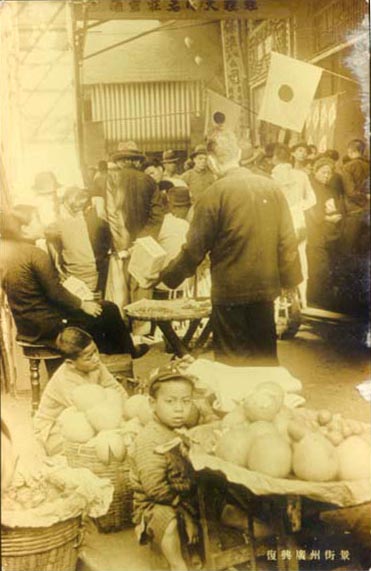
復興廣州街景
Historical Overview
The Second Sino-Japanese War, known in China as the War of Resistance Against Japan, was fought between the Republic of China and the Empire of Japan and its puppet states between 1937 and 1945, following a period of war localized to Manchuria that started in 1931. It is often regarded as the beginning of World War II in Asia, as the wars became heavily intertwined after Japan attacked the United States. It was the largest Asian war in the 20th century.
Outcome & Quick Facts
Outcome
Jap. victory.
Related Literature


Der Gulag

Die Schlacht um Berlin und das Ende des Dritten Reichs 1945

Hunde, wollt ihr ewig leben: ein Stalingrad-Roman

Roter Hunger: Stalins Krieg gegen die Ukraine

So weit die Füße tragen

Söldner ohne Sold: Die deutschen Freikorps 1918–1923

Vom Massensturm zur Stoßtrupptaktik: Die deutsche Landkriegtaktik im Spiegel von Dienstvorschriften und Publizistik 1906 bis 1918

Wir Wehr-Wölfe: Erinnerungen eines Freikorps-Führers

Zweiter Weltkrieg Erlebnisbericht Apokalypse Stalingrad: Untergang der 6. Armee 1942-1943
Walter Mönch
Rise And Fall Of The Third Reich
William Shirer