All Conflicts

Op. Overlord

nullongoing0 battles

"In Case of Failure" Message Drafted by General Dwight Eisenhower in Case the D-Day Invasion Failed

"In Case of Failure" Message Drafted by General Dwight Eisenhower in Case the D-Day Invasion Failed

Author: Unknown authorUnknown author or not providedLicense:PD
Source
A LCVP (Landing Craft, Vehicle, Personnel) from the U.S. Coast Guard-manned USS Samuel Chase disembarks troops of the U.S. Army's First Division on the morning of June 6, 1944 (D-Day) at Omaha Beach.
A LCVP (Landing Craft, Vehicle, Personnel) from the U.S. Coast Guard-manned USS Samuel Chase disembarks troops of the U.S. Army's First Division on the morning of June 6, 1944 (D-Day) at Omaha Beach.

Author: Chief Photographer's Mate (CPHOM) Robert F. Sargent, U.S. Coast GuardLicense:PD
Source
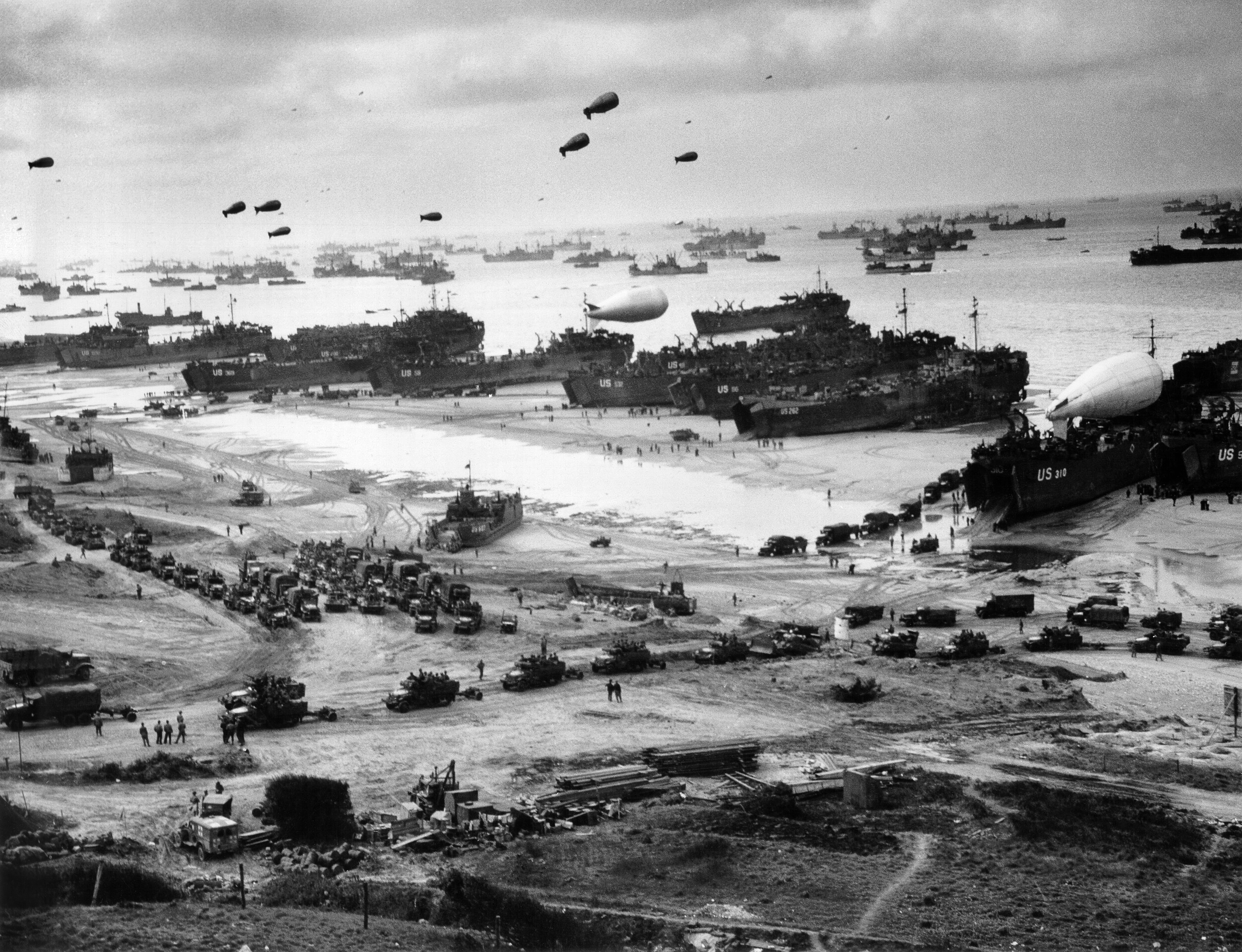
Landing ships putting cargo ashore on Omaha Beach at low tide during the early days of the Allied invasion, mid-June 1944.
Among identifiable ships present are LST-532 (in the center of the view); USS LST-262 (3rd LST from right); USS LST-310 (2nd LST from right); USS LST-533 (partially visible at far right); and USS LST-524. Note barrage balloons overhead and U.S. Army "half-track" convoy forming up on the beach.  The LST-262 was one of 10 Coast Guard-manned LSTs that participated in the invasion of Normandy, France.

This is a retouched edit of the original file which can be found here. This version has had dust and scratches removed, slight tonal imbalances corrected and a tiny white residual border cropped out, otherwise as per the original. Edited and uploaded by mikaultalk 13:18, 16 April 2007 (UTC)

Landing ships putting cargo ashore on Omaha Beach at low tide during the early days of the Allied invasion, mid-June 1944. Among identifiable ships present are LST-532 (in the center of the view); USS LST-262 (3rd LST from right); USS LST-310 (2nd LST from right); USS LST-533 (partially visible at far right); and USS LST-524. Note barrage balloons overhead and U.S. Army "half-track" convoy forming up on the beach. The LST-262 was one of 10 Coast Guard-manned LSTs that participated in the invasion of Normandy, France. This is a retouched edit of the original file which can be found here. This version has had dust and scratches removed, slight tonal imbalances corrected and a tiny white residual border cropped out, otherwise as per the original. Edited and uploaded by mikaultalk 13:18, 16 April 2007 (UTC)

Author: The original uploader was MIckStephenson at English Wikipedia.License:PD
Source
"Deliver for "D" Day!"

"Deliver for "D" Day!"

Author: Unknown authorUnknown author or not providedLicense:PD
Source
"Deliver for "D" Day!

"Deliver for "D" Day!

Author: Unknown authorUnknown author or not providedLicense:PD
Source
On 6 June 1944 a huge military machine embarked on the invasion of German-occupied France. Its target was the coast of Normandy. A vast armada of ships carried more than 130,000 men. Ahead of them, planes and gliders transported another 23,000. This was the biggest amphibious landing in history, and its aim was to end the war in Europe and bring victory to the Allies.
While no New Zealand military units landed on the beaches of Normandy, individual New Zealanders did. Other New Zealanders were on the ships and planes that carried troops to France on 6 June – D-Day – and in the months that followed. These young men served with the Royal Air Force (RAF), Royal Navy (RN) or Merchant Navy. Some were in charge of landing craft, vessels that carried troops and tanks to the invasion. Others were seamen or officers on battleships, destroyers or hospital ships. New Zealanders in the RAF were among the crews of Dakotas and gliders, which carried airborne troops. Other New Zealanders flew in fighters and bombers, sent out on operations in support of the landings.
More information about D-Day and New Zealand’s involvement can be found on NZ History: https://nzhistory.govt.nz/war/d-day" rel="nofollow">nzhistory.govt.nz/war/d-day
This map comes from a Secret military publication that was printed after the invasion and used for training and analysis. One of a series, it shows the landing force approaches, landing sites, and German defences.
Archives New Zealand reference: ABFK W3948 Box 7 - ‘Battle Summaries - Battle Summary No 39, Volume 1 - Operation 'Neptune' Landings in Normandy, June 1944’
https://archway.archives.govt.nz/ViewFullItem.do?code=160595" rel="nofollow">archway.archives.govt.nz/ViewFullItem.do?code=160595 
For more information use our “ask an archivist” link on our website: https://www.archives.govt.nz" rel="nofollow">www.archives.govt.nz
Material from Archives New Zealand Te Rua Mahara o te Kāwanatanga

Caption information from the NZ History feature on D-Day

On 6 June 1944 a huge military machine embarked on the invasion of German-occupied France. Its target was the coast of Normandy. A vast armada of ships carried more than 130,000 men. Ahead of them, planes and gliders transported another 23,000. This was the biggest amphibious landing in history, and its aim was to end the war in Europe and bring victory to the Allies. While no New Zealand military units landed on the beaches of Normandy, individual New Zealanders did. Other New Zealanders were on the ships and planes that carried troops to France on 6 June – D-Day – and in the months that followed. These young men served with the Royal Air Force (RAF), Royal Navy (RN) or Merchant Navy. Some were in charge of landing craft, vessels that carried troops and tanks to the invasion. Others were seamen or officers on battleships, destroyers or hospital ships. New Zealanders in the RAF were among the crews of Dakotas and gliders, which carried airborne troops. Other New Zealanders flew in fighters and bombers, sent out on operations in support of the landings. More information about D-Day and New Zealand’s involvement can be found on NZ History: https://nzhistory.govt.nz/war/d-day" rel="nofollow">nzhistory.govt.nz/war/d-day This map comes from a Secret military publication that was printed after the invasion and used for training and analysis. One of a series, it shows the landing force approaches, landing sites, and German defences. Archives New Zealand reference: ABFK W3948 Box 7 - ‘Battle Summaries - Battle Summary No 39, Volume 1 - Operation 'Neptune' Landings in Normandy, June 1944’ https://archway.archives.govt.nz/ViewFullItem.do?code=160595" rel="nofollow">archway.archives.govt.nz/ViewFullItem.do?code=160595 For more information use our “ask an archivist” link on our website: https://www.archives.govt.nz" rel="nofollow">www.archives.govt.nz Material from Archives New Zealand Te Rua Mahara o te Kāwanatanga Caption information from the NZ History feature on D-Day

Author: Archives New Zealand from New ZealandLicense:CC-BY-4.0
Source
Title / Titre : Lance-Bombardier Walter Cooper, 14th Field Regiment, Royal Canadian Artillery (R.C.A.), aboard a Landing Ship Tank counting out 105mm. shells which will be fired on D-Day. Southampton, England, 4 June 1944
Creator(s) / Créateur(s) : Lieutenant Frank L. Dubervill
Date(s) : June 4, 1944 / 4 juin 1944
Reference No. / Numéro de référence : MIKAN 3526092
collectionscanada.gc.ca/ourl/res.php?url_ver=Z39.88-2004&...
Location / Lieu : Southampton, England / Southhampton, Angleterre
Credit / Mention de source : 
Lieutenant Frank L. Dubervill. Canada. Department  of National Defence.  Library and Archives Canada, PA-191020 / 

Lieutenant Frank L. Dubervill. Canada. Ministère de la défense nationale. Bibliothèque et Archives Canada, PA-191020

Title / Titre : Lance-Bombardier Walter Cooper, 14th Field Regiment, Royal Canadian Artillery (R.C.A.), aboard a Landing Ship Tank counting out 105mm. shells which will be fired on D-Day. Southampton, England, 4 June 1944 Creator(s) / Créateur(s) : Lieutenant Frank L. Dubervill Date(s) : June 4, 1944 / 4 juin 1944 Reference No. / Numéro de référence : MIKAN 3526092 collectionscanada.gc.ca/ourl/res.php?url_ver=Z39.88-2004&... Location / Lieu : Southampton, England / Southhampton, Angleterre Credit / Mention de source : Lieutenant Frank L. Dubervill. Canada. Department of National Defence. Library and Archives Canada, PA-191020 / Lieutenant Frank L. Dubervill. Canada. Ministère de la défense nationale. Bibliothèque et Archives Canada, PA-191020

Author: BiblioArchives / LibraryArchives from CanadaLicense:CC-BY-4.0
Source
Senior commanders of the 16th Infantry Regimental Combat Team  taken in England prior to the assault on Omaha Beach (D-Day). (Left to right): Colonel George A. Taylor,  16th Regiment Commander; Lieutenant Colonel George Gibbs, 7th Field Artillery Battalion Commander; Lieutenant Colonel Herbert Hicks, 2nd Battalion Commander; Lieutenant Colonel Charles T. Horner Jr., 3rd Battalion Commander; Lieutenant Colonel Edmond Driscoll, 1st Battalion Commander.

Senior commanders of the 16th Infantry Regimental Combat Team taken in England prior to the assault on Omaha Beach (D-Day). (Left to right): Colonel George A. Taylor, 16th Regiment Commander; Lieutenant Colonel George Gibbs, 7th Field Artillery Battalion Commander; Lieutenant Colonel Herbert Hicks, 2nd Battalion Commander; Lieutenant Colonel Charles T. Horner Jr., 3rd Battalion Commander; Lieutenant Colonel Edmond Driscoll, 1st Battalion Commander.

Author: U.S. ArmyLicense:PD
Source
Personnel of the 1st Canadian Parachute Battalion, about to leave for the D-Day transit camp, England, May 1944

Personnel of the 1st Canadian Parachute Battalion, about to leave for the D-Day transit camp, England, May 1944

Author: Canada. Department of National Defence. Library and Archives Canada, e002852749License:CC-BY-4.0
Source
IWM caption : THE BRITISH ARMY IN THE NORMANDY CAMPAIGN 1944. Commandos of 1st Special Service Brigade with captured Germans on the roof of their jeep at the glider landing grounds near Ranville, 7 June 1944. Note the Horsa gliders in the background.

IWM caption : THE BRITISH ARMY IN THE NORMANDY CAMPAIGN 1944. Commandos of 1st Special Service Brigade with captured Germans on the roof of their jeep at the glider landing grounds near Ranville, 7 June 1944. Note the Horsa gliders in the background.

Author: Christie (Sgt) No 5 Army Film & Photographic UnitLicense:PD
Source
Accession: 2010-28-1
Satchel, Instruments, Luftwaffe, Pouch 
11"H, 7.5" W, 3"D.
The satchel was found on Utah Beach, Normandy in 1944.  The interior of the satchel contains a canvas pouch with a plastic grid sheet used to calculate bombing runs, marked "Zielgevierttafel." Included in the pouch is another small grid square used to measure ratio/ distance, marked " Franz Kulmann Wilhelmshaven 1940."  There would have been four instruments in the case originally. 

Collection of Curator Branch, Naval History and Heritage Command.

Accession: 2010-28-1 Satchel, Instruments, Luftwaffe, Pouch 11"H, 7.5" W, 3"D. The satchel was found on Utah Beach, Normandy in 1944. The interior of the satchel contains a canvas pouch with a plastic grid sheet used to calculate bombing runs, marked "Zielgevierttafel." Included in the pouch is another small grid square used to measure ratio/ distance, marked " Franz Kulmann Wilhelmshaven 1940." There would have been four instruments in the case originally. Collection of Curator Branch, Naval History and Heritage Command.

Author: Naval History & Heritage Command from Washington, DC, USALicense:CC-BY-4.0
Source
Accession: 2010-28-1
Satchel, Instruments, Luftwaffe, Interior View
11"H, 7.5" W, 3"D.
The satchel was found on Utah Beach, Normandy in 1944.  The interior of the satchel contains a canvas pouch with a plastic grid sheet used to calculate bombing runs, marked "Zielgevierttafel." Included in the pouch is another small grid square used to measure ratio/ distance, marked " Franz Kulmann Wilhelmshaven 1940."  There would have been four instruments in the case originally. 

Collection of Curator Branch, Naval History and Heritage Command.

Accession: 2010-28-1 Satchel, Instruments, Luftwaffe, Interior View 11"H, 7.5" W, 3"D. The satchel was found on Utah Beach, Normandy in 1944. The interior of the satchel contains a canvas pouch with a plastic grid sheet used to calculate bombing runs, marked "Zielgevierttafel." Included in the pouch is another small grid square used to measure ratio/ distance, marked " Franz Kulmann Wilhelmshaven 1940." There would have been four instruments in the case originally. Collection of Curator Branch, Naval History and Heritage Command.

Author: Naval History & Heritage Command from Washington, DC, USALicense:CC-BY-4.0
Source
Accession: 2010-28-1
Satchel, Instruments, Luftwaffe, Obverse.
11"H, 7.5" W, 3"D.
The satchel was found on Utah Beach, Normandy in 1944.  The interior of the satchel contains a canvas pouch with a plastic grid sheet used to calculate bombing runs, marked "Zielgevierttafel." Included in the pouch is another small grid square used to measure ratio/ distance, marked " Franz Kulmann Wilhelmshaven 1940."  There would have been four instruments in the case originally. 

Collection of Curator Branch, Naval History and Heritage Command.

Accession: 2010-28-1 Satchel, Instruments, Luftwaffe, Obverse. 11"H, 7.5" W, 3"D. The satchel was found on Utah Beach, Normandy in 1944. The interior of the satchel contains a canvas pouch with a plastic grid sheet used to calculate bombing runs, marked "Zielgevierttafel." Included in the pouch is another small grid square used to measure ratio/ distance, marked " Franz Kulmann Wilhelmshaven 1940." There would have been four instruments in the case originally. Collection of Curator Branch, Naval History and Heritage Command.

Author: Naval History & Heritage Command from Washington, DC, USALicense:CC-BY-4.0
Source
Accession: 2010-28-1
Satchel, Instruments, Luftwaffe, Reverse.
11"H, 7.5" W, 3"D.
The satchel was found on Utah Beach, Normandy in 1944.  The interior of the satchel contains a canvas pouch with a plastic grid sheet used to calculate bombing runs, marked "Zielgevierttafel." Included in the pouch is another small grid square used to measure ratio/ distance, marked " Franz Kulmann Wilhelmshaven 1940."  There would have been four instruments in the case originally. 

Collection of Curator Branch, Naval History and Heritage Command.

Accession: 2010-28-1 Satchel, Instruments, Luftwaffe, Reverse. 11"H, 7.5" W, 3"D. The satchel was found on Utah Beach, Normandy in 1944. The interior of the satchel contains a canvas pouch with a plastic grid sheet used to calculate bombing runs, marked "Zielgevierttafel." Included in the pouch is another small grid square used to measure ratio/ distance, marked " Franz Kulmann Wilhelmshaven 1940." There would have been four instruments in the case originally. Collection of Curator Branch, Naval History and Heritage Command.

Author: Naval History & Heritage Command from Washington, DC, USALicense:CC-BY-4.0
Source
Soldiers from the 325th Infantry Regiment in a Horsa glider in their way to France during D-Day. The Horsa glider, actually the Airspeed AS.51 Horsa, was a British troop-carrying glider used during WWII. At the end of the war over 3,600 units had been built by Airspeed Limited, and was named after Horsa, the legendary 5th-century conqueror of southern Britain. Military gliders’ objective was to carry infantry troops to a combat zone. These engineless aircraft were towed into the air and most of the way to their target by military transport planes. Once released from the tow craft near the front, they were to land on any convenient open terrain close to target, hopefully with as little damage to the cargo and crew as possible. Nevertheless, results were different to theory, with several shattered gliders hitting the floor and killing all the passengers.

 #historiansunion #colored #colorized #colourised #colorization #colourisation #color #colour #history #ww1 #wwi #worldwarone #greatwar #thegreatwar #ww2 #wwii #worldwartwo #military #war #allies #pilots #france #glider #horsaglider #dday

Soldiers from the 325th Infantry Regiment in a Horsa glider in their way to France during D-Day. The Horsa glider, actually the Airspeed AS.51 Horsa, was a British troop-carrying glider used during WWII. At the end of the war over 3,600 units had been built by Airspeed Limited, and was named after Horsa, the legendary 5th-century conqueror of southern Britain. Military gliders’ objective was to carry infantry troops to a combat zone. These engineless aircraft were towed into the air and most of the way to their target by military transport planes. Once released from the tow craft near the front, they were to land on any convenient open terrain close to target, hopefully with as little damage to the cargo and crew as possible. Nevertheless, results were different to theory, with several shattered gliders hitting the floor and killing all the passengers. #historiansunion #colored #colorized #colourised #colorization #colourisation #color #colour #history #ww1 #wwi #worldwarone #greatwar #thegreatwar #ww2 #wwii #worldwartwo #military #war #allies #pilots #france #glider #horsaglider #dday

Author: Cassowary ColorizationsLicense:CC-BY-4.0
Source
IWM caption : THE BRITISH ARMY IN THE NORMANDY CAMPAIGN 1944. Commandos of 1st Special Service Brigade digging in near Horsa gliders on 6th Airborne's lodgement zone east of the River Orne.

IWM caption : THE BRITISH ARMY IN THE NORMANDY CAMPAIGN 1944. Commandos of 1st Special Service Brigade digging in near Horsa gliders on 6th Airborne's lodgement zone east of the River Orne.

Author: Christie (Sgt), No 5 Army Film & Photographic UnitLicense:PD
Source
USS LCI(L)-553 and USS LCI(L)-410 land troops on Omaha Beach, during the initial assault there on D-Day, 6 June 1944. Photographed from the conning station of another LCI(L) LCI(L)-553, hit by two shells, was left a wreck on the beach on D-Day. Official U.S. Navy Photograph, now in the collections of the National Archives.

USS LCI(L)-553 and USS LCI(L)-410 land troops on Omaha Beach, during the initial assault there on D-Day, 6 June 1944. Photographed from the conning station of another LCI(L) LCI(L)-553, hit by two shells, was left a wreck on the beach on D-Day. Official U.S. Navy Photograph, now in the collections of the National Archives.

Author: Naval History and Heritage CommandLicense:PD
Source
image: A view of a deck of a ship in a rough sea. Soldiers sit huddled in groups. One sits alone, slumped against a wall looking seasick. A soldier stands in the centre of the deck, leaning to maintain balance while talking to a seated man.  On the left side of the deck is a covered wooden lifeboat.  A  green flag flies above the ship.
In the taped interview, in the series 'Artists in an Age of Conflict', commissioned by the IWM in 1978 (Interviewer: Conway Lloyd-Morgan), Ardizzone described the crossing for the Normandy landings: 'Oh, on the way over, my word that was a beastly crossing, it was very rough. And down below it was hell.'
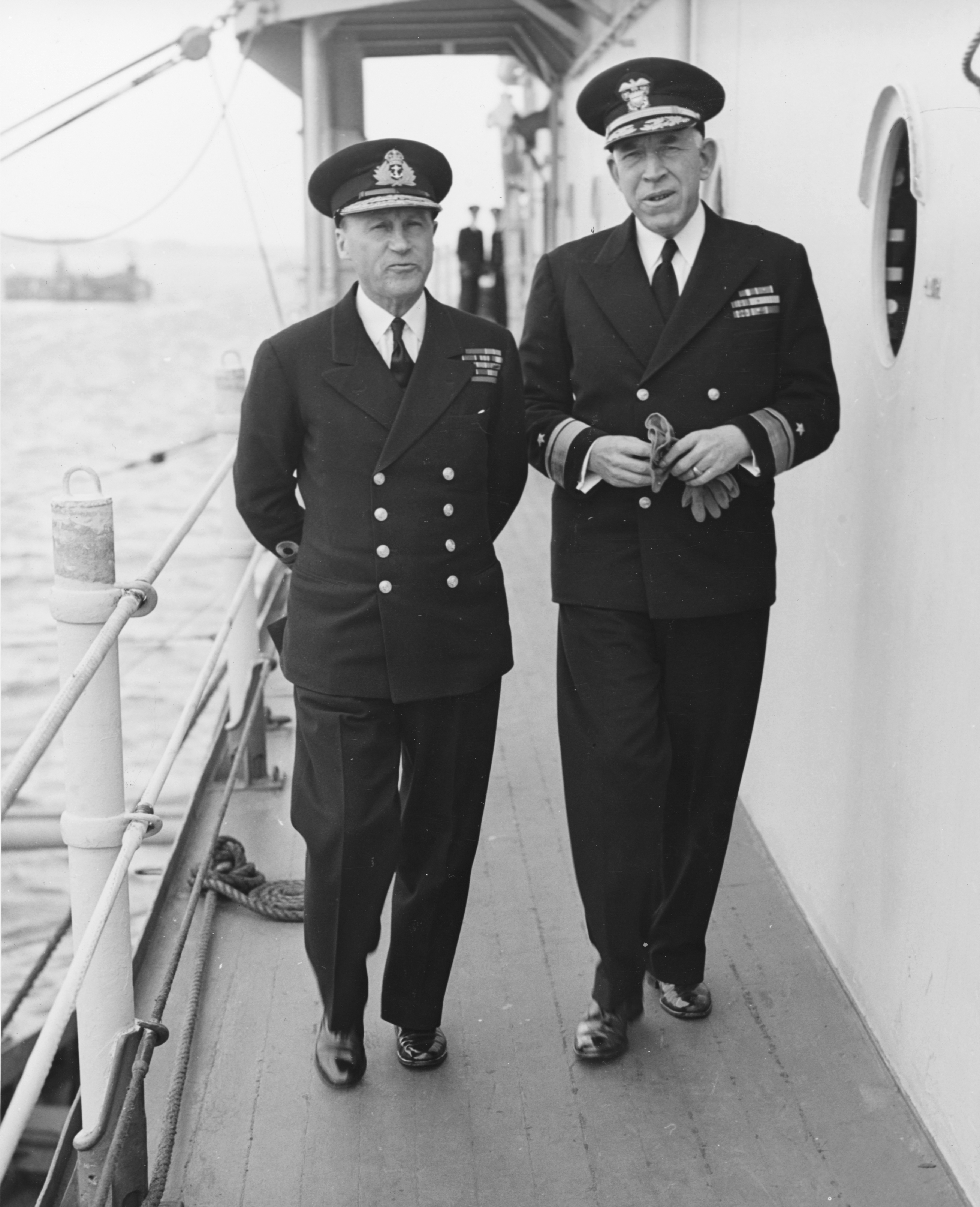
image: A view of a deck of a ship in a rough sea. Soldiers sit huddled in groups. One sits alone, slumped against a wall looking seasick. A soldier stands in the centre of the deck, leaning to maintain balance while talking to a seated man. On the left side of the deck is a covered wooden lifeboat. A green flag flies above the ship. In the taped interview, in the series 'Artists in an Age of Conflict', commissioned by the IWM in 1978 (Interviewer: Conway Lloyd-Morgan), Ardizzone described the crossing for the Normandy landings: 'Oh, on the way over, my word that was a beastly crossing, it was very rough. And down below it was hell.'

Author: Edward ArdizzoneLicense:PD
Source
Admiral Sir Bertram Ramsay, Royal Navy (left), Naval commander of the Normandy operation
with Rear Admiral John L. Hall, Jr., USN (right), Commander Task Force 124, the "Omaha" Beach Assault Force on board the U.S. Navy amphibious command ship USS Ancon (AGC-4) on 25 May 1944, as preparations were underway for the invasion of France.

Admiral Sir Bertram Ramsay, Royal Navy (left), Naval commander of the Normandy operation with Rear Admiral John L. Hall, Jr., USN (right), Commander Task Force 124, the "Omaha" Beach Assault Force on board the U.S. Navy amphibious command ship USS Ancon (AGC-4) on 25 May 1944, as preparations were underway for the invasion of France.

Author: U.S. Navy photo 80-G-45713License:PD
Source
Airborne troops admire the graffiti chalked on the side of their glider as they prepare to fly out as part of the second drop on Normandy on the night of 6th June 1944.
Airborne troops of 6th Airlanding Brigade admire the graffiti chalked on the side of their Horsa glider at an RAF airfield as they prepare to fly out to Normandy as part of 6th Airborne Division's second lift on the evening of 6 June 1944.

Airborne troops admire the graffiti chalked on the side of their glider as they prepare to fly out as part of the second drop on Normandy on the night of 6th June 1944. Airborne troops of 6th Airlanding Brigade admire the graffiti chalked on the side of their Horsa glider at an RAF airfield as they prepare to fly out to Normandy as part of 6th Airborne Division's second lift on the evening of 6 June 1944.

Author: War Office official photographer, Malindine E G (Capt)License:PD
Source
Airspeed Horsa Glider at the Pegasus Bridge Memorial, Normandy France

Airspeed Horsa Glider at the Pegasus Bridge Memorial, Normandy France

Author: SakralamnLicense:CC-BY-SA-4.0
Source
The USA cemetery at Normandy, France. The photo has been taken in October 2025

The USA cemetery at Normandy, France. The photo has been taken in October 2025

Author: Geraldshields11License:CC-BY-SA-4.0
Source
Funneling in thousands of reinforcements, the armada of LCIs stretches to the horizon under its umbrella of barrage balloons.
U.S. Coast Guard Public Relations Photo.

026-g-037-051-001

Funneling in thousands of reinforcements, the armada of LCIs stretches to the horizon under its umbrella of barrage balloons. U.S. Coast Guard Public Relations Photo. 026-g-037-051-001

Author: Signal Corps Archive from Ireland and United StatesLicense:PD
Source
Original Caption: "Members of an American landing party lending helping hands to other members of their organization whose landing craft was sunk by enemy France, off the coast of France..."

Original Caption: "Members of an American landing party lending helping hands to other members of their organization whose landing craft was sunk by enemy France, off the coast of France..."

Author: Department of Defense. Department of the Army. Office of the Chief Signal Officer. (9/18/1947 - 3/1/1964)License:PD
Source
American soldiers recover the dead after D-Day

American soldiers recover the dead after D-Day

Author: US ArmyLicense:PD
Source
Original Caption: "American soldiers who died in the crash-landing of their glider during the invasion, near St. Marie Du Mont, Utah Beach, France." Original Field Number: ETO-HQ-44-4986-36. Photographer: Montgomery

Original Caption: "American soldiers who died in the crash-landing of their glider during the invasion, near St. Marie Du Mont, Utah Beach, France." Original Field Number: ETO-HQ-44-4986-36. Photographer: Montgomery

Author: Department of Defense. Department of the Army. Office of the Chief Signal Officer. (9/18/1947 - 3/1/1964)License:PD
Source
American soldiers, hardened and ready, lounge under full fighting equipment on the deck of a Coast Guard assault transport in the fateful trip across the English Channel.

American soldiers, hardened and ready, lounge under full fighting equipment on the deck of a Coast Guard assault transport in the fateful trip across the English Channel.

Author: Unknown authorUnknown author or not providedLicense:PD
Source

Historical Overview

Allied invasion of Nazi-occupied Western Europe beginning with the Normandy landings in 1944.

Outcome & Quick Facts

Outcome

Allied victory.

Related Literature

Cover of Berlin: The Downfall 1945

Berlin: The Downfall 1945

Antony Beevor

Non-fictionWW2WW2 Eastern Front

English
World Wars Era
Cover of Gulag: A History

Gulag: A History

Non-fiction20th CenturySoviet Union

English
World Wars Era
Cover of Red Famine: Stalin's War on Ukraine

Red Famine: Stalin's War on Ukraine

Non-fiction20th CenturySoviet Union

English
World Wars Era
Cover of Stalingrad

Stalingrad

Antony Beevor

WW2ReportWW2 Eastern Front

English
World Wars Era
Cover of The Gulag Archipelago

The Gulag Archipelago

Non-fiction20th CenturySoviet Union

English
World Wars Era
Cover of Der Gulag

Der Gulag

Non-fiction20th CenturySoviet Union

German
World Wars Era
Cover of Die Schlacht um Berlin und das Ende des Dritten Reichs 1945

Die Schlacht um Berlin und das Ende des Dritten Reichs 1945

Non-fictionWW2WW2 Eastern Front

German
World Wars Era
Cover of Hunde, wollt ihr ewig leben: ein Stalingrad-Roman

Hunde, wollt ihr ewig leben: ein Stalingrad-Roman

WW2WW2 Eastern FrontHistorical Noval

German
World Wars Era
Cover of Roter Hunger: Stalins Krieg gegen die Ukraine

Roter Hunger: Stalins Krieg gegen die Ukraine

Non-fiction20th CenturySoviet Union

German
World Wars Era
Cover of So weit die Füße tragen

So weit die Füße tragen

20th CenturySoviet UnionGulag

German
World Wars Era
Cover of Söldner ohne Sold: Die deutschen Freikorps 1918–1923

Söldner ohne Sold: Die deutschen Freikorps 1918–1923

Report20th CenturyGerman History

German
World Wars Era
Cover of Vom Massensturm zur Stoßtrupptaktik: Die deutsche Landkriegtaktik im Spiegel von Dienstvorschriften und Publizistik 1906 bis 1918

Vom Massensturm zur Stoßtrupptaktik: Die deutsche Landkriegtaktik im Spiegel von Dienstvorschriften und Publizistik 1906 bis 1918

Non-fiction20th CenturyGerman History

German
World Wars Era
Cover of Wir Wehr-Wölfe: Erinnerungen eines Freikorps-Führers

Wir Wehr-Wölfe: Erinnerungen eines Freikorps-Führers

Report20th CenturyGerman History

German
World Wars Era
Cover of Zweiter Weltkrieg Erlebnisbericht Apokalypse Stalingrad: Untergang der 6. Armee 1942-1943

Zweiter Weltkrieg Erlebnisbericht Apokalypse Stalingrad: Untergang der 6. Armee 1942-1943

Walter Mönch

Non-fictionWW2WW2 Eastern Front

German
World Wars Era
Rise And Fall Of The Third Reich

Rise And Fall Of The Third Reich

William Shirer

20th CenturyGerman HistoryNational Socialism

World Wars Era