Egyptian Campaign

Saint-Gilles (Gard, Languedoc, France), Espeyran castle, in the stables, the tack room. Skeleton of an Arab thoroughbred horse, named "Active", brought back from Egypt by General Bonaparte.

Battle of the Pyramids, July 21, 1798, oil on canvas 389 x 311 cm

Cemetery of French Soldiers of Napoleon Egypte Expedition, Fomm el-Khaleeg - Cairo - Egypt

This map is from Hauet's manuscripts which describe the French invasion of France. It shows the theater of operations in Upper Egypt.
![BELLIARD, Auguste Daniel (Fontenay-le-Comte 1769 – Bruxelles 1832). Général en 1796, comté de l’Empire le 9 mars 1810. Servit à Valmy, Jemmapes, Neerwinden, armée de l’Ouest en 1795, en Italie 1796, servit à Castiglione, au pont d’Arcole, armée d’Egypte en 1798, aux Pyramides, vainqueur de plusieurs combats, gouverneur du Caire, se signala à Wertingen, Austerlitz, Jena, à la prise d’Erfurt, Lübeck, Golymin, Eylau, Friedland, chef d’état-major de Murat en Espagne 1808, gouverneur de Madrid en 1808, servit en Russie sous Murat, aux combats d’Ostrowno, de Witepsk, Smolensk, à la Moskowa, en Allemagne 1813, eut le bras fracassé par un boulet à Leipzig en octobre 1813.
Lettre autographe signée comme commandant la place de Caire au général Reynier au Caire. LE CAIRE (Egypte), 14 pluviose an IX (3 février 1801).
Je suis a la poursuite mon cher Reignier du nommé Aboudefi, qui a fait afficher dans le Caire une lettre incendiaire ; on m’a rendu compte qu’il s’etait refugié chez le chesi de Kaloubie, nommé Savarby .... je [prie] vous de lui ecrire et de lui ordonner de le conduire au Caire, Aboudefi
Bonjour
Belliard
1 p. in-fol. (coin inférieur du papier à droite restauré) avec belle et très rare vignette et adresse avec contreseing. Belle pièce.](https://upload.wikimedia.org/wikipedia/commons/2/29/1801_G%C3%A9n%C3%A9ral_BELLIARD_autographe_LE_CAIRE_Kairo-back.jpg)
BELLIARD, Auguste Daniel (Fontenay-le-Comte 1769 – Bruxelles 1832). Général en 1796, comté de l’Empire le 9 mars 1810. Servit à Valmy, Jemmapes, Neerwinden, armée de l’Ouest en 1795, en Italie 1796, servit à Castiglione, au pont d’Arcole, armée d’Egypte en 1798, aux Pyramides, vainqueur de plusieurs combats, gouverneur du Caire, se signala à Wertingen, Austerlitz, Jena, à la prise d’Erfurt, Lübeck, Golymin, Eylau, Friedland, chef d’état-major de Murat en Espagne 1808, gouverneur de Madrid en 1808, servit en Russie sous Murat, aux combats d’Ostrowno, de Witepsk, Smolensk, à la Moskowa, en Allemagne 1813, eut le bras fracassé par un boulet à Leipzig en octobre 1813. Lettre autographe signée comme commandant la place de Caire au général Reynier au Caire. LE CAIRE (Egypte), 14 pluviose an IX (3 février 1801). Je suis a la poursuite mon cher Reignier du nommé Aboudefi, qui a fait afficher dans le Caire une lettre incendiaire ; on m’a rendu compte qu’il s’etait refugié chez le chesi de Kaloubie, nommé Savarby .... je [prie] vous de lui ecrire et de lui ordonner de le conduire au Caire, Aboudefi Bonjour Belliard 1 p. in-fol. (coin inférieur du papier à droite restauré) avec belle et très rare vignette et adresse avec contreseing. Belle pièce.
![BELLIARD, Auguste Daniel (Fontenay-le-Comte 1769 – Bruxelles 1832). Général en 1796, comté de l’Empire le 9 mars 1810. Servit à Valmy, Jemmapes, Neerwinden, armée de l’Ouest en 1795, en Italie 1796, servit à Castiglione, au pont d’Arcole, armée d’Egypte en 1798, aux Pyramides, vainqueur de plusieurs combats, gouverneur du Caire, se signala à Wertingen, Austerlitz, Jena, à la prise d’Erfurt, Lübeck, Golymin, Eylau, Friedland, chef d’état-major de Murat en Espagne 1808, gouverneur de Madrid en 1808, servit en Russie sous Murat, aux combats d’Ostrowno, de Witepsk, Smolensk, à la Moskowa, en Allemagne 1813, eut le bras fracassé par un boulet à Leipzig en octobre 1813.
Lettre autographe signée comme commandant la place de Caire au général Reynier au Caire. LE CAIRE (Egypte), 14 pluviose an IX (3 février 1801).
Je suis a la poursuite mon cher Reignier du nommé Aboudefi, qui a fait afficher dans le Caire une lettre incendiaire ; on m’a rendu compte qu’il s’etait refugié chez le chesi de Kaloubie, nommé Savarby .... je [prie] vous de lui ecrire et de lui ordonner de le conduire au Caire, Aboudefi
Bonjour
Belliard
1 p. in-fol. (coin inférieur du papier à droite restauré) avec belle et très rare vignette et adresse avec contreseing. Belle pièce.](https://upload.wikimedia.org/wikipedia/commons/a/ad/1801_G%C3%A9n%C3%A9ral_BELLIARD_autographe_LE_CAIRE_Kairo-face.jpg)
BELLIARD, Auguste Daniel (Fontenay-le-Comte 1769 – Bruxelles 1832). Général en 1796, comté de l’Empire le 9 mars 1810. Servit à Valmy, Jemmapes, Neerwinden, armée de l’Ouest en 1795, en Italie 1796, servit à Castiglione, au pont d’Arcole, armée d’Egypte en 1798, aux Pyramides, vainqueur de plusieurs combats, gouverneur du Caire, se signala à Wertingen, Austerlitz, Jena, à la prise d’Erfurt, Lübeck, Golymin, Eylau, Friedland, chef d’état-major de Murat en Espagne 1808, gouverneur de Madrid en 1808, servit en Russie sous Murat, aux combats d’Ostrowno, de Witepsk, Smolensk, à la Moskowa, en Allemagne 1813, eut le bras fracassé par un boulet à Leipzig en octobre 1813. Lettre autographe signée comme commandant la place de Caire au général Reynier au Caire. LE CAIRE (Egypte), 14 pluviose an IX (3 février 1801). Je suis a la poursuite mon cher Reignier du nommé Aboudefi, qui a fait afficher dans le Caire une lettre incendiaire ; on m’a rendu compte qu’il s’etait refugié chez le chesi de Kaloubie, nommé Savarby .... je [prie] vous de lui ecrire et de lui ordonner de le conduire au Caire, Aboudefi Bonjour Belliard 1 p. in-fol. (coin inférieur du papier à droite restauré) avec belle et très rare vignette et adresse avec contreseing. Belle pièce.
Engravings by W. Stack; after F.B. Spilsbury Dedication signed: Edward Orme First published, London, 1803 Abbey, J.R. Travel BAC: British Art Center copy is the Abbey copy. Bound in half roan Subjects:

A cemetery in Beirut by the British naval surgeon Francis Brockell Spilsbury in his book "Picturesque Scenery in the Holy Land and Syria, Delineated during the Campaigns of 1799 and 1800. This view of Mount Lebanon is from the burying ground. The old castle at a distance was built by Constantine the Great: from that to the mountain, the ground is beautifully laid out in mulberry gardens, which serve as nurseries for silk-worms. The mulberry here cultivated is of the white species, and is without taste. The persons who feed the silk-worms, cut off the branches of the trees almost close to the trunks, the young sprouts being intended for the brood of the succeeding year. The huts which shelter these useful insects, are extremely light, being built of reeds and covered with the same material. They are kept remarkably clean, each hut generally having three tiers of little boxes for the worms on each side, and the same in the middle. It was in these gardens, that the author used to take out his convalescent patients on asses, accompanied by his friend Mr. Wright in a chair.

André Galle, Medaille auf den Ägyptischen Feldzug und Napoleon Bonaparte aus dem Privatbesitz Johann Wolfgang von Goethes, 1799–1800, Klassik Stiftung Weimar, Museen, Inv. GMM-1712 (Vorderseite)

Map of the Battle of the Nile from Tārīkh Miṣr al-siyāsī fī al-azminah al-ḥadīthah"

Paire d'étriers arabes équipant l'une des selles utilisées par Henri-Gatien Bertrand lors de la campagne d'Egypte de Napoléon Ier. Cuivre. XIXe siècle. Musée Bertrand, à Châteauroux, dans l'Indre, en France. Inv. 854.1 et 854.2.

Inscription at Philae left by members of Napoleon's invasion of Egypt, dated 13 Ventôse in Year 7 of the Republic (3 March 1799).

Jacob's Bridge, between the lakes of Tiberia, with the tents of the British Army pitched on the mountain side and the tents of the Aga of the Janisaries, the British arrived here on 18 October 1799, during the Defence of the Ottoman Empire against General Bonaparte. Wellcome Images Keywords: D. Orme; Landscape; Francis. B. Spilsbury; Ottoman; War; Napoleon Bonaparte

Jacob's Bridge, between the lakes of Tiberia, with the tents of the British Army pitched on the mountain side and the tents of the Aga of the Janisaries, the British arrived here on 18 October 1799, during the Defence of the Ottoman Empire against General Bonaparte. Sketched on the spot by F.B. Spilsbury. Published in 1803, London.

Jacob's Bridge, between the lakes of Tiberia, with the tents of the British Army pitched on the mountain side and the tents of the Aga of the Janisaries, the British arrived here on 18 October 1799, during the Defence of the Ottoman Empire against General Bonaparte. Sketched on the spot by F.B. Spilsbury. Published in 1803, London.

Portion of map of Pierre Jacotin of northern Palestine, prepared during French military expedition of 1799 and published in 1826. Full name: Carte topographique de l'Egypte et de plusieurs parties des pays limitrophes ... .

Letter to Dominique Larrey from M. Lecomte, dated 13 December 1850. Letter written in French. Dominique Jean Larrey (1766-1842) was chief surgeon to Napoleon's armies, serving on varied campaigns including the Egyptian expedition of 1798 and the Russian campaign of 1812. A favourite of the Emperor, he was made Baron Larrey on the field at the battle of Wagram in 1809. After Napoleon's defeat, Larrey's medical reputation saved him from a fall from grace. His achievements included introducing a system of "flying ambulances" onto the battlefield, to treat and remove the injured. He also wrote a number of works on surgery, which are still widely used. Felix Hippolyte Larrey (1808-1895) was the son of Dominique Larrey, and inherited the title of Baron Larrey on his fathers death in 1842. He was chief medical officer of the army and physician to Napoleon III, and was elected president of the Academie de Medecine in 1863. As well as his medical work, Felix Larrey was the political representative for the town of Bagneres-de-Bigorre in south west France for a number of years Archives & Manuscripts
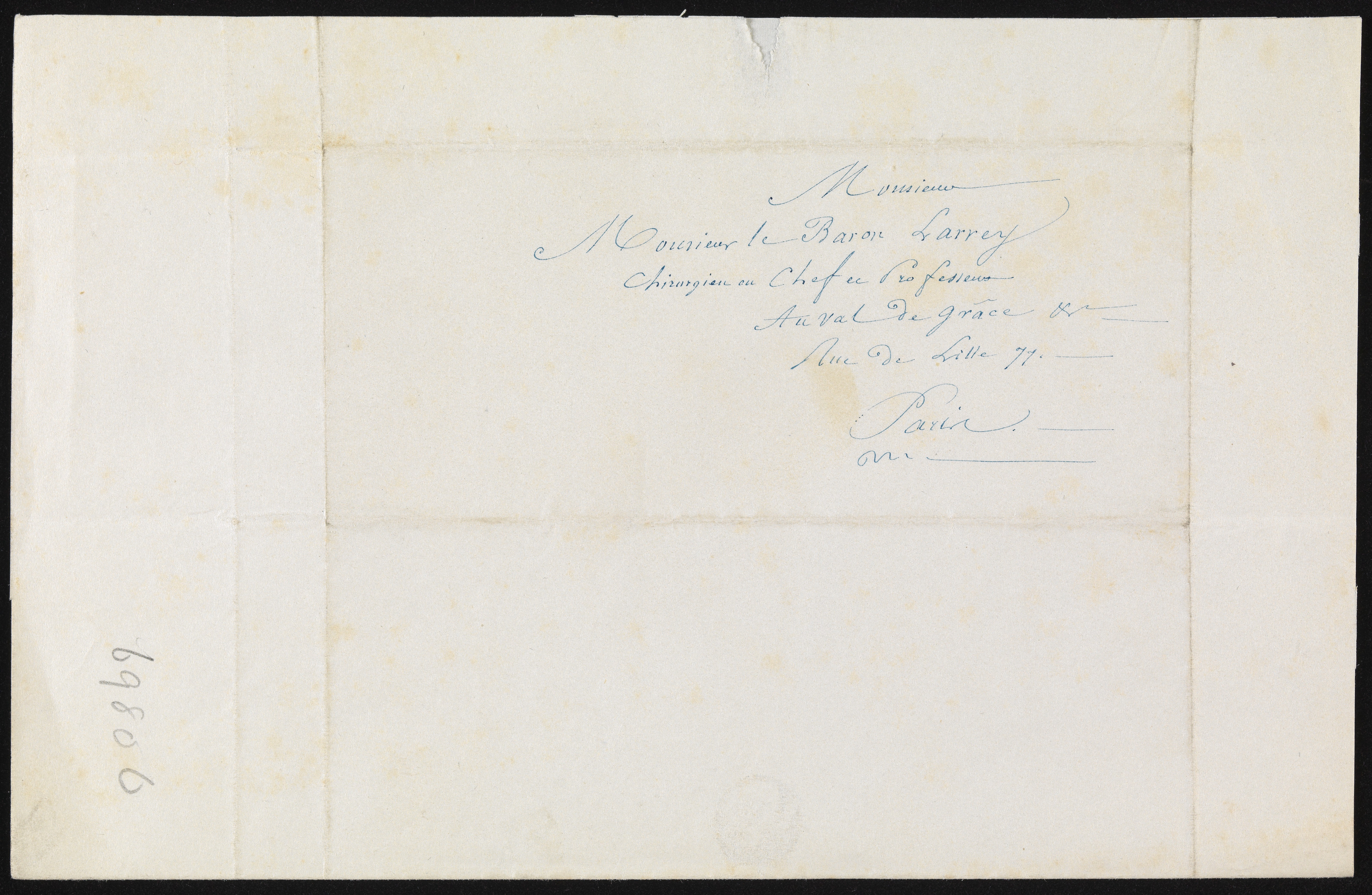
Letter to Dominique Larrey from M. Lecomte, dated 13 December 1850. Letter written in French. Dominique Jean Larrey (1766-1842) was chief surgeon to Napoleon's armies, serving on varied campaigns including the Egyptian expedition of 1798 and the Russian campaign of 1812. A favourite of the Emperor, he was made Baron Larrey on the field at the battle of Wagram in 1809. After Napoleon's defeat, Larrey's medical reputation saved him from a fall from grace. His achievements included introducing a system of "flying ambulances" onto the battlefield, to treat and remove the injured. He also wrote a number of works on surgery, which are still widely used. Felix Hippolyte Larrey (1808-1895) was the son of Dominique Larrey, and inherited the title of Baron Larrey on his fathers death in 1842. He was chief medical officer of the army and physician to Napoleon III, and was elected president of the Academie de Medecine in 1863. As well as his medical work, Felix Larrey was the political representative for the town of Bagneres-de-Bigorre in south west France for a number of years Archives & Manuscripts

Lettre n°100 de Hasan bey al-Jiddâwî à Murâd bey en date du 2 sha’bân 1215-19 décembre 1900
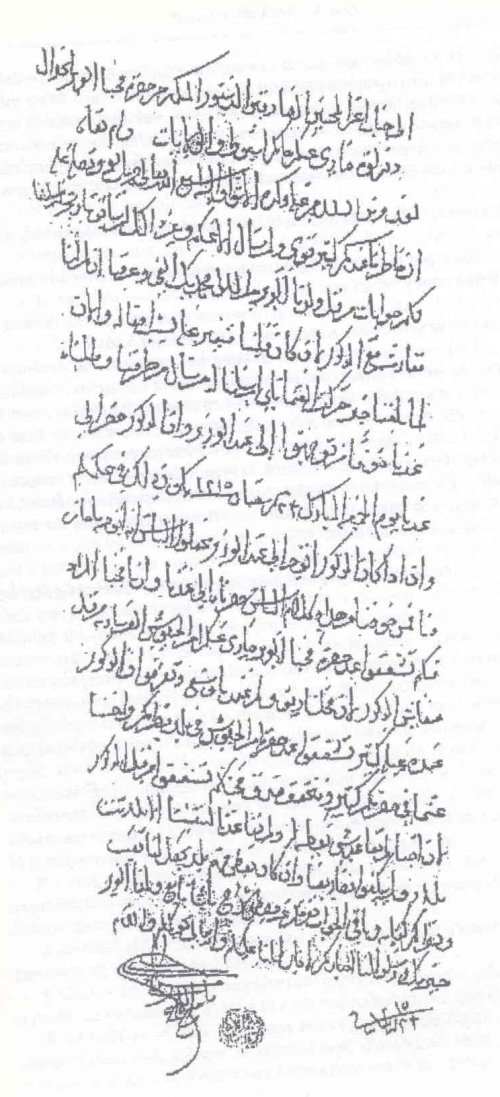
Lettre n°103 de Murâd bey à Donzelot en date du 23 shabân 1215-9 janvier 1801
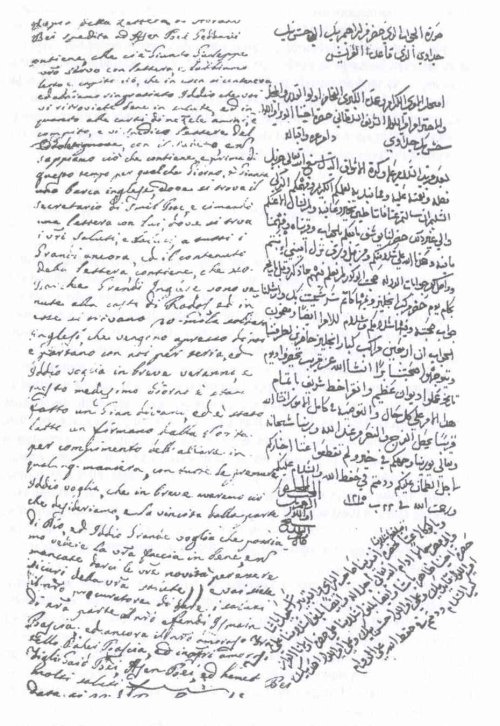
Lettre n°99 de Ibrâhîm bey à Hasan bey al-Jiddâwî en date du 22 rajab 1215-9 décembre 1800

This media is about Maltese cultural property with inventory number 01135.

ru:Сабля Наполеона

Napoleonian text of Campaign in Egypt (1798–1801), Isis Temple, Philae Island, Egypt

Napoleonian text of Campaign in Egypt (1798–1801), Isis Temple, Philae Island, Egypt
Historical Overview
The French invasion of Egypt and Syria (1798–1801) was a military expedition to Ottoman-held Egypt and Syria led by Napoleon Bonaparte during the French Revolutionary Wars. The campaign aimed to undermine British trade routes, expand French influence, and establish a scientific and administrative presence in Egypt. Napoleon also sought to sever Britain's connection to its colonial holdings in India, with the long-term ambition of challenging British dominance in the region.
Outcome & Quick Facts
Outcome
Decisive French victory.
Related Literature

