Battle of Plassey

Plassey, 1757

Lord Clive meeting with Mir Jafar after the Battle of Plassey
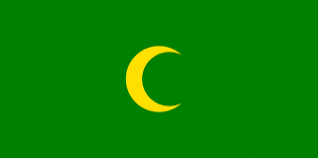
This is a (1857) captured flag of the Mughal Empire, the flag is known to have been Mughal green in colour. This flag was utilized during the Carnatic Wars and possibly during the Battle of Plassey. This flag was ultimately captured by the British Empire in the year 1857.

9 (Plassey) Battery RA logo, which stands as the battery flag. First designed for the battery upon winning the battle of plassey in 1757.

9 (Plassey) Battery RA logo, which stands as the battery flag. First designed for the battery upon winning the battle of plassey in 1757.

Arrival of the Nawab before Clive's position at Plassey.
![Famous British Battles, Plassey June 25, 1737
[Original caption] Plassey. A small village in Bengal, celebrated for the famous victory of Lord Clive, June 23, 1757. With 3,000 men he defeated the Nabob Surajah Dowlah and his vast host of 60,000 men at a loss to himself of only 20 white men and 50 sepoys. This battle decided the fate of Bengal and secured India for Britain. [end]
Colonial mythology relied on the continuous reproduction of stories and the corresponding visual memorabilia by which imperialism nourished itself, in this case through a postcard almost 200 years after the event based on an illustration by an artist, R. Caton Woodville, known for his glorification of the British army. Note the distinction between races of casualties in the caption. In this case, the postcard on the back was also used as an "Undissected Duplicate of a Tuck's Picture Puzzle Postcard for Progressive Picture Puzzle Parties, etc.," testifying to the way these images were also woven into a performative social fabric, endlessly rehearsed and inculcated thousands of miles from the battle scene.](https://upload.wikimedia.org/wikipedia/commons/e/e6/Clive_Examining_the_Enemy%27s_Lines_-_Battle_of_Plassey.jpg)
Famous British Battles, Plassey June 25, 1737 [Original caption] Plassey. A small village in Bengal, celebrated for the famous victory of Lord Clive, June 23, 1757. With 3,000 men he defeated the Nabob Surajah Dowlah and his vast host of 60,000 men at a loss to himself of only 20 white men and 50 sepoys. This battle decided the fate of Bengal and secured India for Britain. [end] Colonial mythology relied on the continuous reproduction of stories and the corresponding visual memorabilia by which imperialism nourished itself, in this case through a postcard almost 200 years after the event based on an illustration by an artist, R. Caton Woodville, known for his glorification of the British army. Note the distinction between races of casualties in the caption. In this case, the postcard on the back was also used as an "Undissected Duplicate of a Tuck's Picture Puzzle Postcard for Progressive Picture Puzzle Parties, etc.," testifying to the way these images were also woven into a performative social fabric, endlessly rehearsed and inculcated thousands of miles from the battle scene.

A little visit in London Une petite visite a Londres

The imperialism is repugnant, but there is no doubt that this rare card by British publisher C.W. Faulkner & Co. is a masterpiece of design. From the writing space to the coloured flag over the triton portrait, the gold and silver, the sense of dignified restraint, the portrait of Clive of India and the roster of his battles – all combine to great effect. Heraldic cards, designed by the English painter and sculptor Frederick Leighton (1830-1896), were an early specialty of Faulkner. As for Clive, as William Dalrymple relates so nicely in The Anarchy (2019), his many battlefield successes and great stolen wealth hardly translated into happiness.

Medal commemorating battle of Plassey

Medal commemorating the battle of Plassey

This work by William Watts (active 1737-58) is an account of the Battle of Plassey, which took place on June 23, 1757, near the village of Pâlāshir, some 150 kilometers north of Calcutta (present-day Kolkata). In this decisive encounter, the forces of the British East India Company, under Robert Clive, defeated Siraj Ud Daulah, the last independent Nawab of Bengal. The British victory and the treaty with the Moghul Empire that ensued brought the province of Bengal and its great wealth under the control of the company, thereby establishing the basis for the expansion of British control in the rest of India. The French East India Company (La Compagnie des Indes Orientales) supported the nawab, and his defeat hastened the elimination of French influence in India. The “Meer Jaffeir” referred to in the title is Mir Jafar, one of Siraj-ud-Daulah's military commanders, who betrayed his leader and helped to cause the defeat. The British East India Company later selected Mir Jafar as its puppet ruler in Bengal. Battle of Plassey; East India Company; Great Britain--Colonies
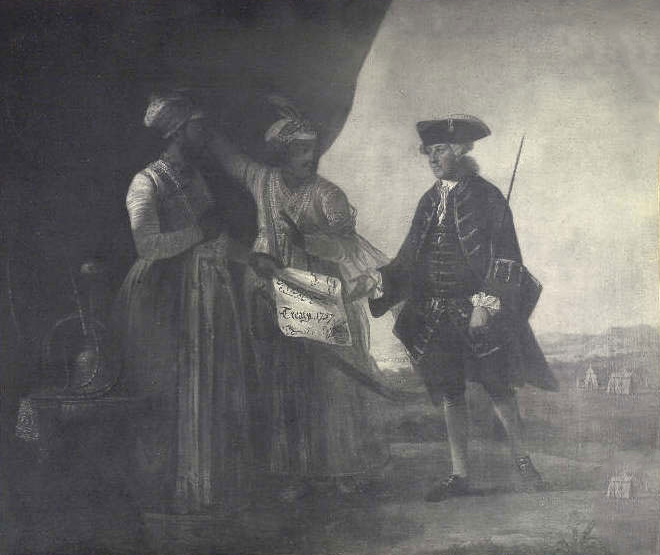
Mir Jafar and his son Miran delivering the Treaty of 1757 to William Watts. Platinotype by Henry Dixon and Son, London, c.1890.

Mir Jafar's Plassey Medal

The medal awarded to Mir Jafar at Plassey after his conspiracy against the last independent Nawab of Bengal, Siraj-ud-Daulah.

Battle of Plassey, 23rd June 1757; Decisive British East India Company victory over the Nawab of Bengal and his French allies, establishing Company rule in India;
This film showcases the 'Palashi ki Jung' or the Battle of Plassey, the historic event which changed the course of the modern India. It has immense historic, economic and political influence as the consequences which followed were so vast, immediate and permanent. According to many historians, the Battle of Plassey is considered as the starting point to the events that established the era of British domination and conquest of India. The film uses re-enactments, illustrated drawings and archival stills to reconstruct the court of Siraj-ud-Daulah and the events leading up to the Battle of Plassey, the betrayal by the Nawab's lieutenants and the subsequent defeat and death of Siraj-ud-Daulah.

Robert Clive and Mir Jafar after the Battle of Plassey, 1757, by Francis Hayman. See source website for additional information.

The battle of Plassey, June 23, 1757. From Hutchinson's story of the nations, containing the Egyptians, the Chinese, India, the Babylonian nation, the Hittites, the Assyrians, the Phoenicians and the Carthaginians, the Phrygians, the Lydians, and other nations of Asia Minor.

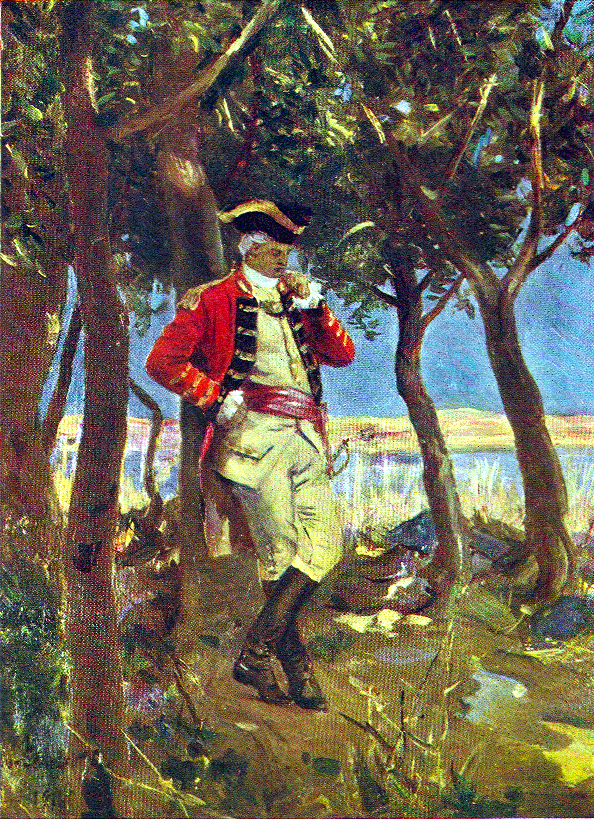
Clive examining the enemy lines from the roof of the Navab's hunting lodge; the Navab's arrival before Clive's position; the Navab's artillery on a special movable platform: three commemorative views of the Battle of Plassey from the Illustrated London News, 1893
This history of India begins well before era of British colonization, during the age of the invasion of Alexander the Great, which was the west's first contact with the east. For much of the next millennium various Moslem lords rules parts of northern India. Finally, in the eighteenth century, France and Britain contested for control of the Asian trade centered in India, and for the following two centuries, India was Britain's most important colony.
Historical Overview
The Battle of Plassey was a decisive victory of the British East India Company, under the leadership of Robert Clive, over the Nawab of Bengal and his French allies on 23 June 1757. The victory was made possible by the betrayal of Mir Jafar, Nawab Siraj-ud-Daulah's commander in chief, as well as much of the Bengal Subah's armies being earlier committed against an Afghan invasion led by Ahmad Shah Durrani against the Mughal Empire. The battle helped the British East India Company take complete control of Bengal in 1773. Over the next hundred years, they continued to expand their control over vast territories in the rest of the Indian subcontinent and Burma.
Quick Facts
British East India Company
- Commander: Robert Clive
- Strength: ca. 3.000
- Casualties: ca. 20
Bengal & France
- Commander: Siraj-ud-Daulah
- Strength: ca. 50.000
- Casualties: ca. 500
Strategic Context
Power struggle between the East India Company and the Nawab of Bengal (supported by France).
Conflict / War
Seven Years' War
Historical Locations
Interactive map requires third-party cookie consent.