Sack of Rome
![French: Le sac de Rome par les barbares en 410[1]The Sack of Rome by the Barbarians in 410title QS:P1476,fr:"Le sac de Rome par les barbares en 410[1]"label QS:Lfr,"Le sac de Rome par les barbares en 410[1]"label QS:Les,"El saqueo de Roma en el año 410 por los vándalos"label QS:Lde,"Die Plünderung Roms durch die Barbaren 410"label QS:Len,"The Sack of Rome by the Barbarians in 410"label QS:Lnl,"De plundering van Rome in 410 door de Vandalen"](https://upload.wikimedia.org/wikipedia/commons/a/a0/Sack_of_Rome_by_the_Visigoths_on_24_August_410_by_JN_Sylvestre_1890.jpg)
French: Le sac de Rome par les barbares en 410[1]The Sack of Rome by the Barbarians in 410title QS:P1476,fr:"Le sac de Rome par les barbares en 410[1]"label QS:Lfr,"Le sac de Rome par les barbares en 410[1]"label QS:Les,"El saqueo de Roma en el año 410 por los vándalos"label QS:Lde,"Die Plünderung Roms durch die Barbaren 410"label QS:Len,"The Sack of Rome by the Barbarians in 410"label QS:Lnl,"De plundering van Rome in 410 door de Vandalen"

Alaric deposed (Priscus) Attalus from the throne, 410 (E. Bendemann)

Eroberung roms 410

Le Sac de Rome par Evariste-Vital Luminais. New-York, Sherpherd Gallery.

Alarich in Rom
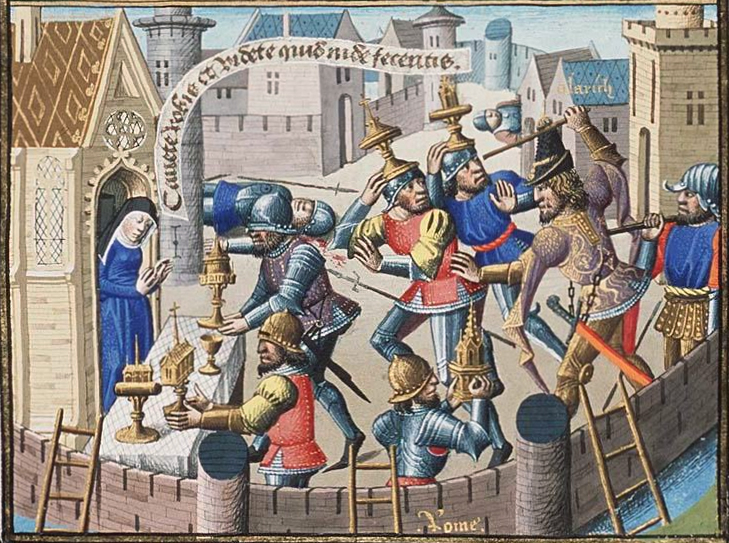
Augustine, La Cité de Dieu (Vol. I). Translation from the Latin by Raoul de Presles: Sack of Rome by Alaric - sacred vessels are brought to a church for safety (2nd of 2 images). Place of origin, date: Paris, Maïtre François (illuminator); c. 1475; 1478-1480 Material: Vellum, ff. 467, 440x300 (270x185) mm, 46 lines, littera hybrida, Binding: 18th-century brown leather (c. 1769) Decoration: 11 two-column miniatures (257/204x190/177 mm); 277 column miniatures (c. 120x80 mm); 11 illustrations in the margin (coats of arms); decorated initials with border decoration Provenance: made for Jacques d'Armagnac, duke of Nemours (1433-1477) and after his capture continued for Philippe de Commines (1447-1511), lord of Argenton (coats of arms in margin and on edge). Purchased in 1751 at the sale of J.-A. Crozat de Tugny (1696-1751) at Thiboust, Paris,by L.-J. Gaignat of Paris; purchased in 1769 at the Gaignat sale at G.F. De Bure le Jeune, Paris (cat. 1 Febr., no. 242) by Gerard Meerman (1722-1771) of Rotterdam, later The Hague; by descent to his son Johan Meerman (1753-1815); acquired between 1816 and 1824 by Willem H.J vanWestreenen van Tiellandt (1783-1848) of The Hague; by legacy to the kingdom of the Netherlands Annotation: Vol. II now: Nantes, BM, fr. 8

Siege of Rome by Alaric I, 410
Historical Overview
The sack of Rome on 24 August 410 AD was undertaken by the Visigoths led by their king, Alaric. At that time, Rome was no longer the administrative capital of the Western Roman Empire, having been replaced first by Mediolanum in 286 and then by Ravenna in 402. Nevertheless, the city of Rome retained a paramount position as "the eternal city" and a spiritual center of the Empire. This was the first time in almost 800 years that Rome had fallen to a foreign enemy, and the sack was a major shock to contemporaries, friends and foes of the Empire alike.
Quick Facts
Visigoths
- Commander: Alarich I.
- Strength: ca. 40.000 Mann
- Casualties: Gering
Western Roman Empire
- Commander: Kaiser Honorius (in Ravenna)
- Strength: ca. 5.000 (Stadtgarde)
- Casualties: Hoch (Zivilbevölkerung)
Strategic Context
Alaric's ultimate leverage following failed negotiations over land grants and payments.
Conflict / War
Gothic Wars
Related Literature

Geschichte der Spätantike: Das Römische Reich von Diocletian bis Justinian 284-565 n. Chr.
Historical Locations
Interactive map requires third-party cookie consent.