Siege of Baghdad
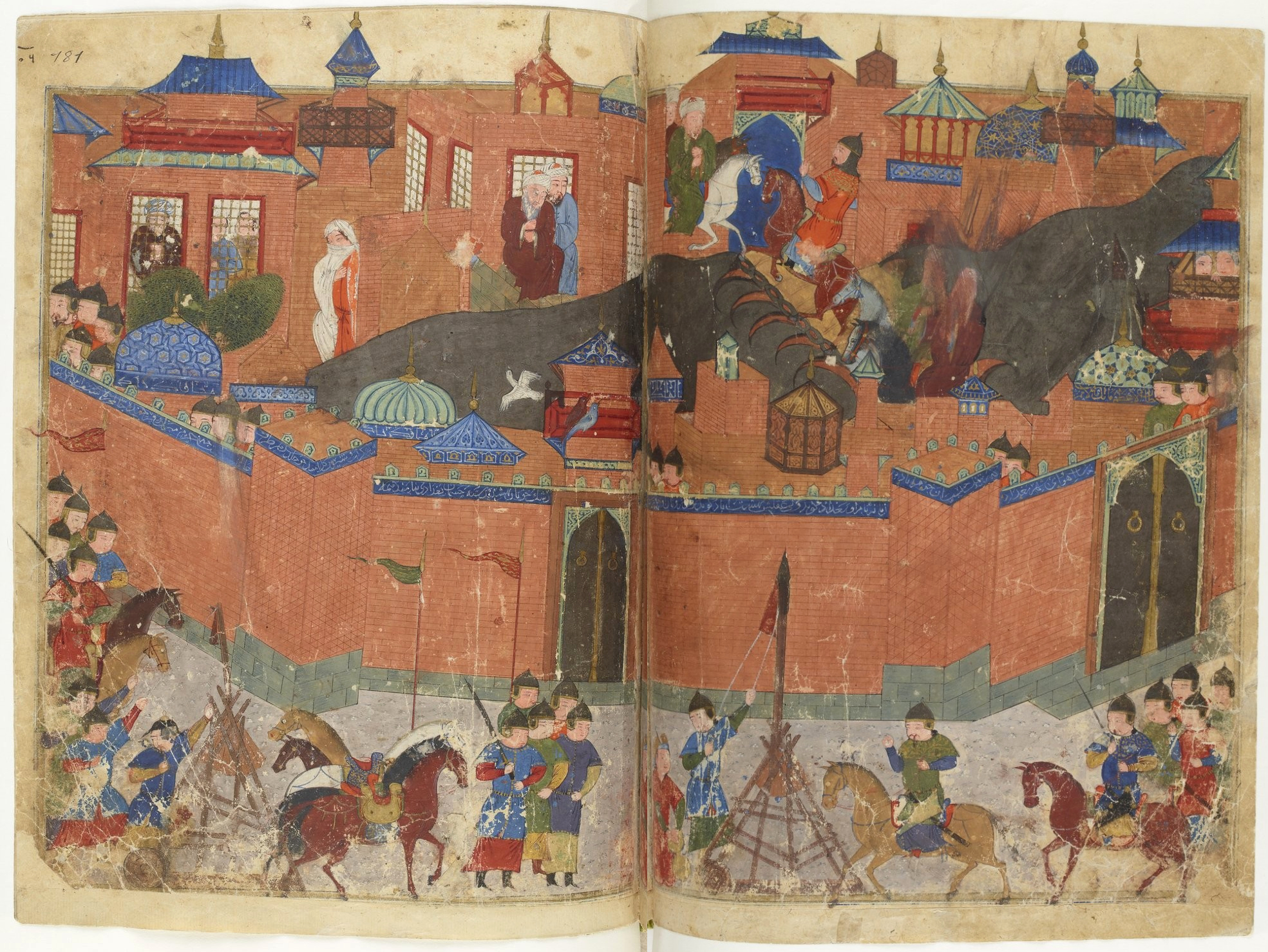
Mongols besieging Baghdad in 1258

The Mongol ruler Hulagu in Baghdad interns the Caliph of Baghdad among his treasures.

Mongols besieging Baghdad in 1258

Mongols besieging Baghdad in 1258
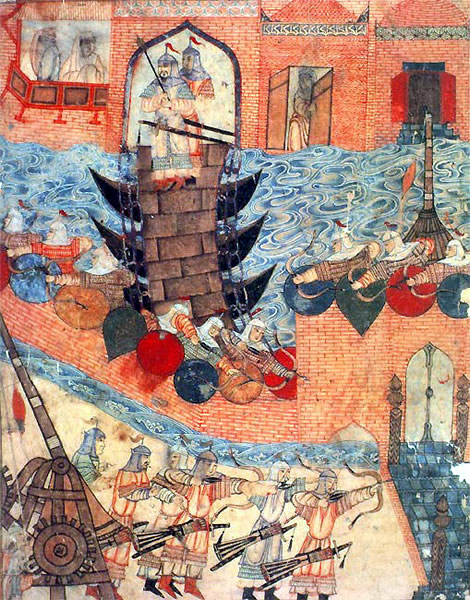
Siege on Baghdad by the Mongols led by Hulagu Khan 1258

Caliph al-Musta'ṣim (detail). Folio 89v (British Library, Or 2780)

Execution. Illustration of Rashid-ad-Din's Gami' at-tawarih. Tabriz (?), 1st quarter of 14th century. Water colours on paper. Original size: 18.5 cm x 26.2 cm. Staatsbibliothek Berlin, Orientabteilung, Diez A fol. 70, p. 49. The executed - long and full beard probably means he is not a Mongol - has been thrown off a cliff.

Conquest of Baghdad by the Mongols 1258. Right part of a double-page illustration of Rashid-ad-Din's Gami' at-tawarih. Tabriz (?), 1st quarter of 14th century. Water colours and gold on paper. Original size: 37.4 cm x 29.3 cm. Staatsbibliothek Berlin, Orientabteilung, Diez A fol. 70, p. 4. Note the ponton bridge, siege engine, and the refugee on the boat, maybe a high dignitary or even the calif himself. For the complete illustration, see Image:DiezAlbumsFallOfBaghdad.jpg.
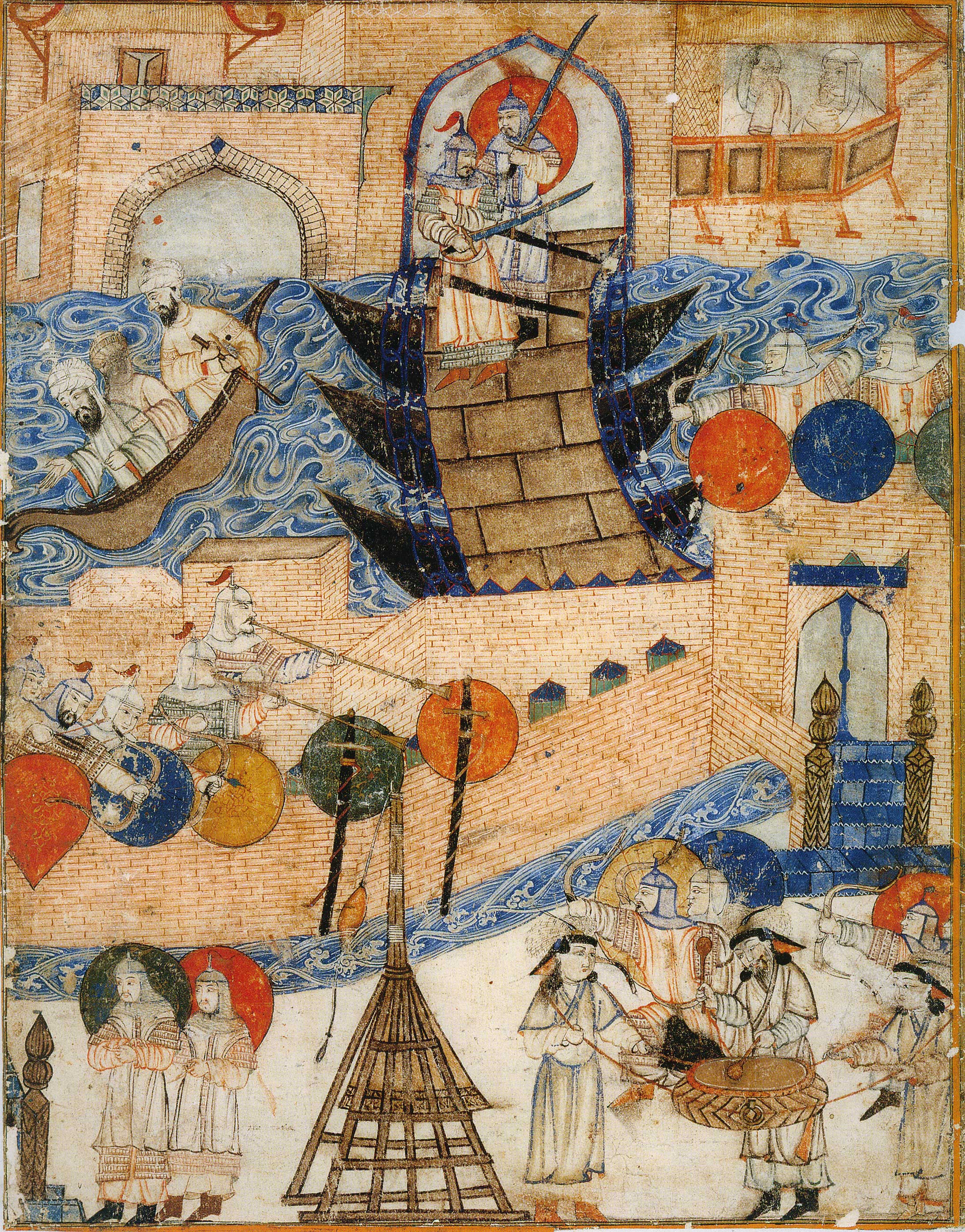
Conquest of Baghdad by the Mongols 1258. Right part of a double-page illustration of Rashid-ad-Din's Gami' at-tawarih. Tabriz (?), 1st quarter of 14th century. Water colours and gold on paper. Original size: 37.4 cm x 29.3 cm. Staatsbibliothek Berlin, Orientabteilung, Diez A fol. 70, p. 4. Note the ponton bridge, siege engine, and the refugee on the boat, maybe a high dignitary or even the calif himself. For the complete illustration, see Image:DiezAlbumsFallOfBaghdad.jpg.

Conquest of Baghdad by the Mongols 1258. Left part of a double-page illustration of Rashid-ad-Din's Gami' at-tawarih. Tabriz (?), 1st quarter of 14th century. Water colours and gold on paper. Original size: 37.2 cm x 29 cm. Staatsbibliothek Berlin, Orientabteilung, Diez A fol. 70, p. 7. Note the ponton bridge and siege engines. For the complete illustration, see Image:DiezAlbumsFallOfBaghdad.jpg.

Conquest of Baghdad by the Mongols 1258. Left part of a double-page illustration of Rashid-ad-Din's Gami' at-tawarih. Tabriz (?), 1st quarter of 14th century. Water colours and gold on paper. Original size: 37.2 cm x 29 cm. Staatsbibliothek Berlin, Orientabteilung, Diez A fol. 70, p. 7. Note the ponton bridge and siege engines. For the complete illustration, see Image:DiezAlbumsFallOfBaghdad.jpg.
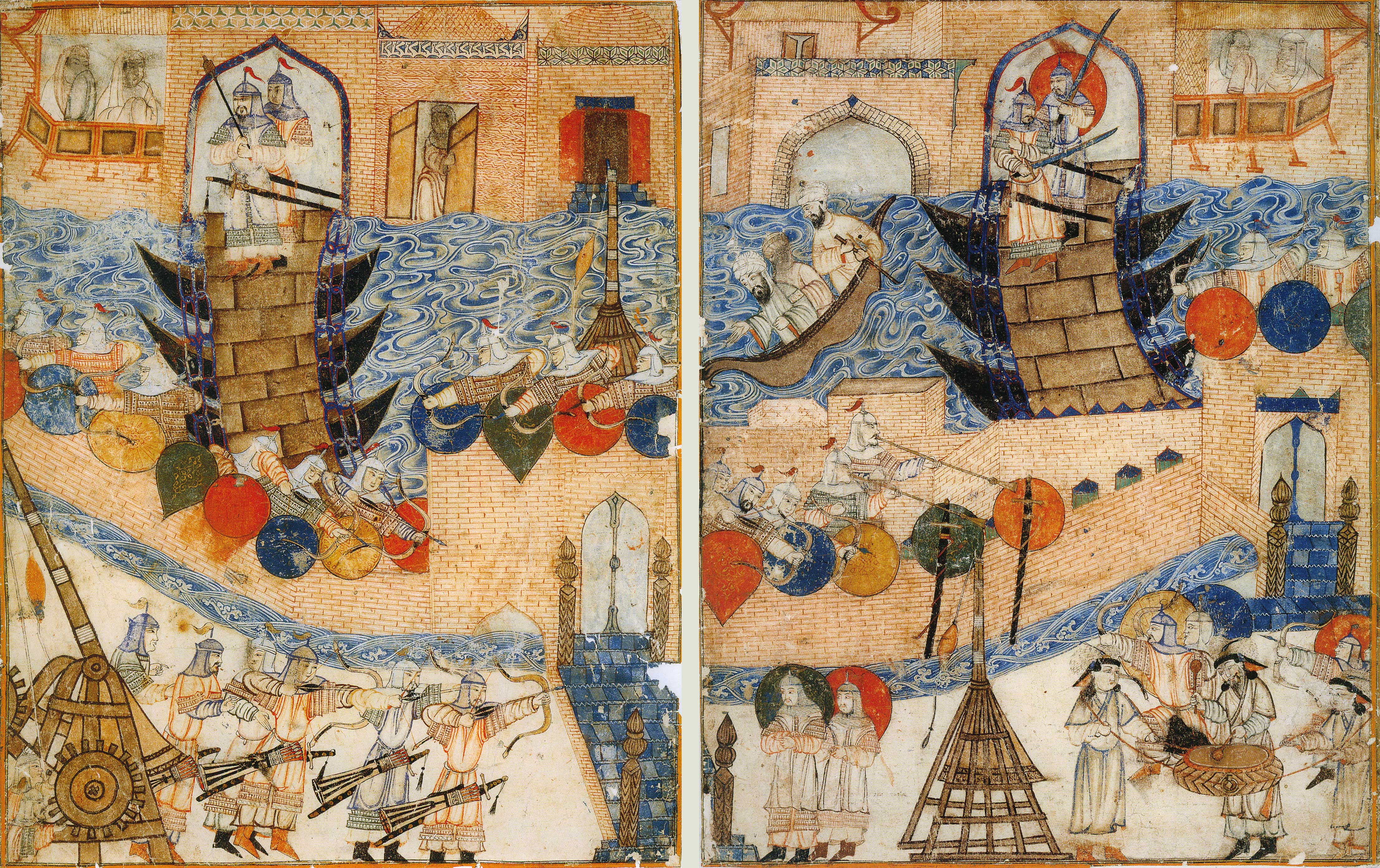
Conquest of Baghdad by the Mongols 1258. Double-page illustration of Rashid-ad-Din's Gami' at-tawarih. Tabriz (?), 1st quarter of 14th century. Water colours and gold on paper. Original size: 37.4 cm x 29.3 cm (right), 37.2 cm x 29 cm (left). Staatsbibliothek Berlin, Orientabteilung, Diez A fol. 70, p. 4 (right) and 7 (left). Note the ponton bridges, siege engines, and the dawatdar (a high official) attempting to flee by boat. For only the left or only the right part of the illustration, see Image:DiezAlbumsFallOfBaghdad_b.jpg and Image:DiezAlbumsFallOfBaghdad_a.jpg.

Fall Of Baghdad (Diez Albums). Detail: a leading official's failed attempt to escape by boat from the city (center right): "The davāt-dār (chief secretary) who commanded the Caliph’s army was encamped between Baʿqūbā and Bājisrā. Hearing that the Mongol army was approaching from the west, the davāt-dār crossed the Tigris and joined battle with the Mongols near Anbār. The Mongols retreated and, joining Baiju ’s main army, opened a canal on the river Tigris. Half of the Caliph’s army was drowned and half was defeated in the attacks that followed. The davāt-dār made an attempt to escape by boat down the Tigris. Being unsuccessful, he fled back to Baghdad." in (2011) The Mongols and the Armenians (1220-1335), Leiden ; Boston: Brill, p. 130 ISBN: 978-90-04-18635-4.

Fall Of Baghdad (Diez Albums). Detail: a leading official's failed attempt to escape by boat from the city (center right): "The davāt-dār (chief secretary) who commanded the Caliph’s army was encamped between Baʿqūbā and Bājisrā. Hearing that the Mongol army was approaching from the west, the davāt-dār crossed the Tigris and joined battle with the Mongols near Anbār. The Mongols retreated and, joining Baiju ’s main army, opened a canal on the river Tigris. Half of the Caliph’s army was drowned and half was defeated in the attacks that followed. The davāt-dār made an attempt to escape by boat down the Tigris. Being unsuccessful, he fled back to Baghdad." in (2011) The Mongols and the Armenians (1220-1335), Leiden ; Boston: Brill, p. 130 ISBN: 978-90-04-18635-4.
Fall Of Baghdad (Diez Albums). Detail: a leading official's failed attempt to escape by boat from the city (center right): "The davāt-dār (chief secretary) who commanded the Caliph’s army was encamped between Baʿqūbā and Bājisrā. Hearing that the Mongol army was approaching from the west, the davāt-dār crossed the Tigris and joined battle with the Mongols near Anbār. The Mongols retreated and, joining Baiju ’s main army, opened a canal on the river Tigris. Half of the Caliph’s army was drowned and half was defeated in the attacks that followed. The davāt-dār made an attempt to escape by boat down the Tigris. Being unsuccessful, he fled back to Baghdad." in (2011) The Mongols and the Armenians (1220-1335), Leiden ; Boston: Brill, p. 130 ISBN: 978-90-04-18635-4.
Conquest of Baghdad by the Mongols 1258. Double-page illustration of Rashid-ad-Din's Gami' at-tawarih. Tabriz (?), 1st quarter of 14th century. Water colours and gold on paper. Original size: 37.4 cm x 29.3 cm (right), 37.2 cm x 29 cm (left). Staatsbibliothek Berlin, Orientabteilung, Diez A fol. 70, p. 4 (right) and 7 (left). Note the ponton bridges, siege engines, and the dawatdar (a high official) attempting to flee by boat.

The Mongol ruler Hulagu in Baghdad interns the Caliph of Baghdad among his treasures.

15th-century miniature from a manuscript of the Chinggisid Shahnameh.
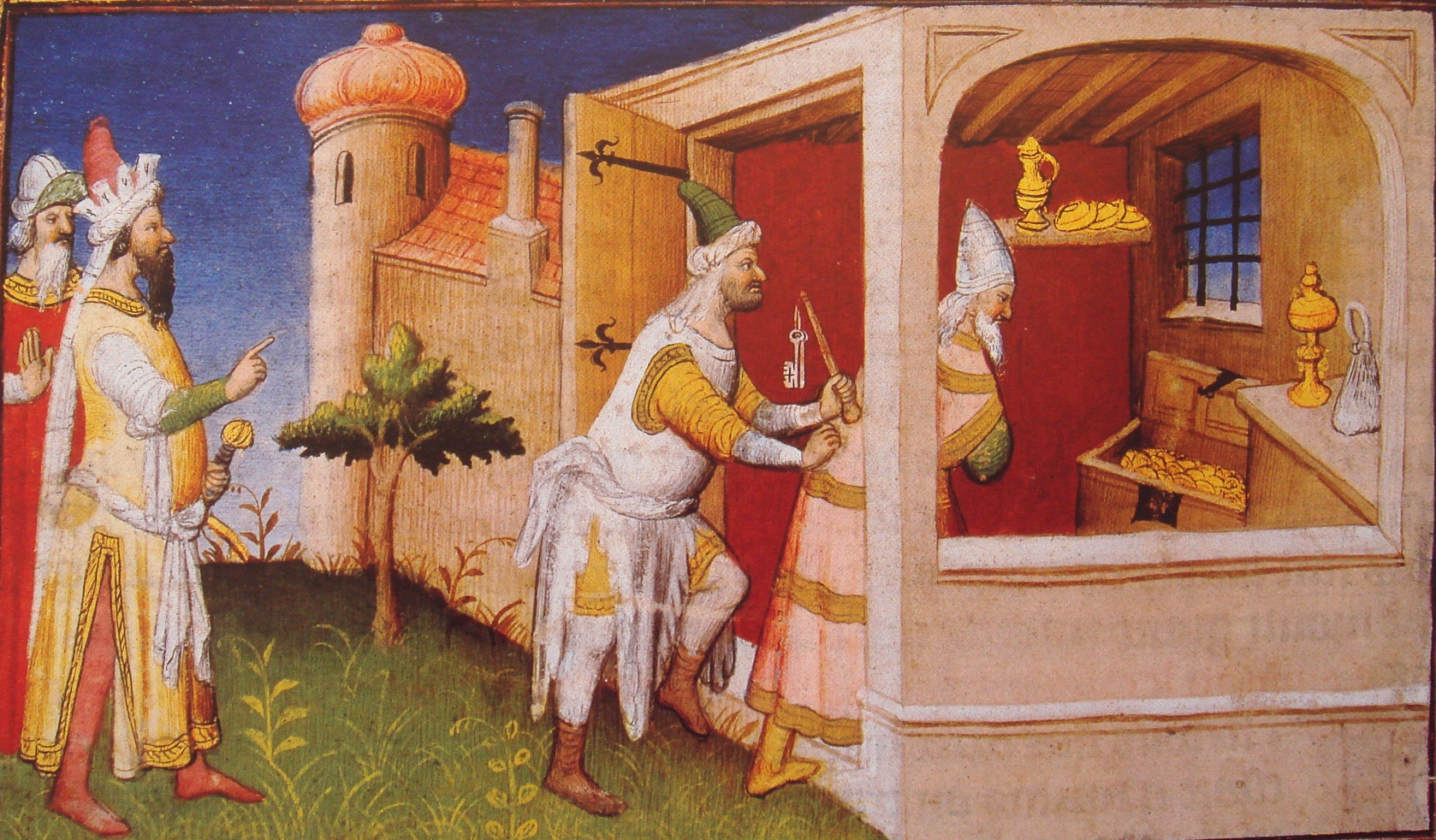
The Mongol ruler Hulagu in Baghdad interns the Caliph of Baghdad among his treasures.

Islamic art in the Cincinnati Art Museum

Islamic art in the Cincinnati Art Museum

Islamic art in the Cincinnati Art Museum

15th-century miniature from a manuscript of the Chinggisid Shahnameh.

Mongol siege techniques in 1221 were little different than those used for the siege of Baghdad in 1258. A 14th century Persian illustration from the Heinrich von Diez Albums, Staatsbibliothek zu Berlin.

Persian painting of Hülegü’s army besieging a city. Note use of the siege engine.
Historical Overview
The Siege of Baghdad, also known as the Sack of Baghdad, took place in early 1258. A large army commanded by Hulegu, a prince of the Mongol Empire, attacked the historic capital of the Abbasid Caliphate after a series of provocations from its ruler, caliph al-Musta'sim. Within a few weeks, Baghdad fell and was sacked by the Mongol army—al-Musta'sim was killed alongside hundreds of thousands of his subjects. The city's fall has traditionally been seen as marking the end of the Islamic Golden Age; in reality, its ramifications are uncertain.
Quick Facts
Ilkhanate
- Commander: Hülegü Khan
- Strength: ca. 150.000
- Casualties: Gering
Abbasid Caliphate
- Commander: Al-Musta'sim †
- Strength: ca. 50.000
- Casualties: Nahezu 100%
Strategic Context
Expansion of the Ilkhanate into the Middle East to subjugate the Caliphate.
Conflict / War
Mongol Expansion
Related Literature


1177 v. Chr.: Der erste Untergang der Zivilisation

Byzanz: Die erstaunliche Geschichte eines mittelalterlichen Imperiums

Das Mittelalter: Europa von 500 bis 1500

Die Karolinger

Im Mittelalter: Handbuch für Zeitreisende

Im Rausch des Vergnügens: Eine Reise in das England von Jane Austen und Lord Byron

Militärgeschichte des Mittelalters

Nach 1177 v. Chr.: Wie Zivilisationen überleben
Der ferne Spiegel: Das dramatische 14. Jahrhundert
Barbara Tuchman
Historical Locations
Interactive map requires third-party cookie consent.